
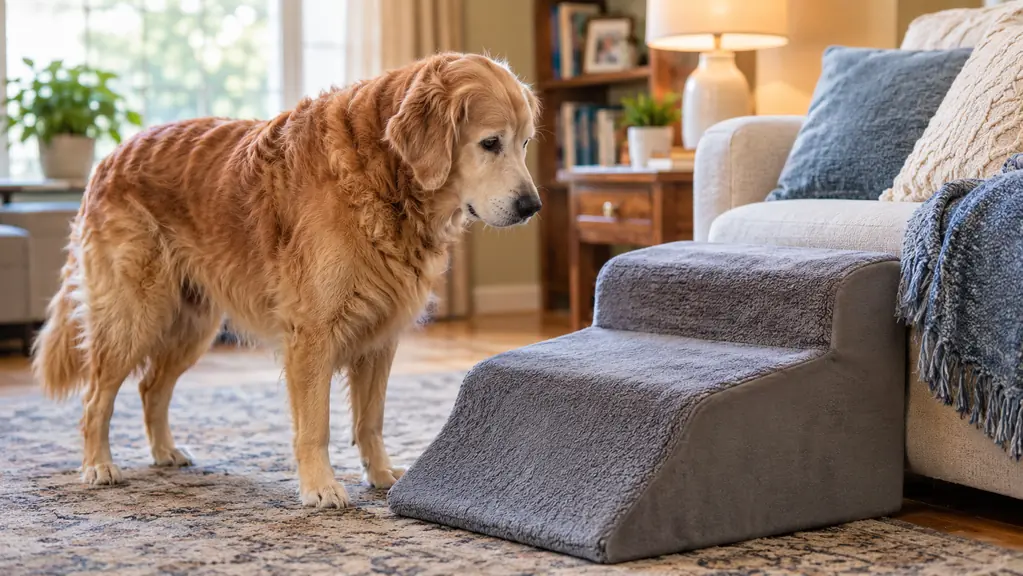
Short answer: at our house the Topmart foam ramp is the one that stayed in the den. Gus is a 12 year old Brittany mix, 46 pounds, and the arthritis in both hips showed up on X-rays in November 2024, worse on the left. What he needed was a way onto the loveseat that did not ask him to lift his back end and land it at the same time. The ramp does that. It is not the right call for every dog in every house, though, and I will get to the places where it loses, because a comparison where one side wins every row is a sales sheet and you can smell those from the driveway.
Two things sit behind that answer. Our loveseat has a seat height of 14 inches, which lands inside the 11 to 15 inch furniture range the ramp is built for. And we had already tried the other thing. In May 2025 we borrowed a neighbor's hard plastic pet stairs for a weekend and set them in front of the same loveseat. Gus went up once with me coaching him. On the way up, his feet slid on the second step. He got there. He also quit offering to go up again, and a dog who stops offering is telling you something. We returned the stairs that Sunday. The ramp came the following month, the week after he misjudged a jump onto the loveseat one evening and slid back down.
Where the ramp lives matters for this comparison, so here it is. It stays beside the loveseat in the den and it is used for that and nothing else. It does not go to the back porch, where we have three wooden steps, and it does not go in the CR-V. A foam ramp at this height is a furniture solution, not an outdoor one. If your problem is a wet porch step, you are shopping for a different piece of equipment, and we solved that separately and later, with something that had nothing to do with foam. The ramp has not moved from that corner since June 2025 except to be vacuumed under, and Mike has stopped asking whether it is in the way, which from him is a full endorsement.
| Topmart Foam Ramp | Hard Plastic Pet Stairs | |
|---|---|---|
| Traction under a paw | Foam gives slightly and his feet stayed where he put them | Molded plastic is slick when a nail lands on it; his feet slid on the second step |
| Weight it will take | Rated to 50 lbs, best comfort under 35; Gus at 46 is close to the ceiling | Rigid plastic carries a heavier dog without compressing under a back paw |
| The rise itself | Two tiers, 11.8 inches high, so weight carries forward instead of straight up | Fixed step heights that ask for a bigger single lift from a sore dog |
| Furniture height | Built for seats 11 to 15 inches high; our loveseat is 14 | Sold at one height, so the fit is whatever you already bought |
| Cleaning up hair and mud | Foam holds hair and grit and has to be wiped or vacuumed | Hoses off in the yard in about a minute |
| Moving it out of the way | 3.9 pounds, one hand, no fuss | Heavier and awkward to drag aside with a foot |
| Staying put on tile | Sits flat and has not wandered | The borrowed set stayed put too; the problem was his feet, not the frame |
| Staying put on carpet | No rocking at all in our carpeted den | Rocked a little at the tile edge when he loaded the second step |
| Best for | Small and medium dogs, 35 lbs and under for daily comfort | Heavier dogs and households that need to wash the thing |
| Warranty | One year, listed on the product page | Varies by brand, and the borrowed set came with no paperwork we saw |
What the Numbers on the Box Actually Mean
The ramp is 21.7 inches deep, 15.7 inches wide, and 11.8 inches high, built in two tiers. It weighs 3.9 pounds. The listing rates it to 50 pounds, with best comfort for dogs under 35. That last number matters here and I am not going to skate past it. Gus is 46 pounds, which is 11 pounds over the comfort ceiling and 4 pounds under the hard limit. He uses it every day and the foam has not bottomed out under him. But if your dog is 60 pounds, this is not the product for you, and no amount of clever writing changes that.
The foam is listed as 30D high density, two layers, treated to hold up over time. After about 17 months of daily use in our den it still holds its shape, and I have not seen it break down at the edge where Gus pushes off to get going. The listing carries a one year warranty, which is more than I expected on a piece of foam. I checked the underside in October 2026, running my hand along both tiers, because that is where cheap foam tells on itself. It came back flat and even, no soft pocket under the second tier where his back paw lands.
The height range is the part people skip past. Furniture between 11 and 15 inches is the target, and our 14 inch loveseat sits near the top of it. If your sofa seat is 20 inches off the floor, you are shopping for a different product, and a two tier foam ramp at that height will feel steep to a dog with sore hips. Measure the seat first. It takes thirty seconds and it is the difference between a useful purchase and a thing in the corner of the den. I measured ours with the same tape I used on the porch steps, and I wrote both numbers on the inside of a cabinet door so I would stop guessing.
Where Topmart Wins
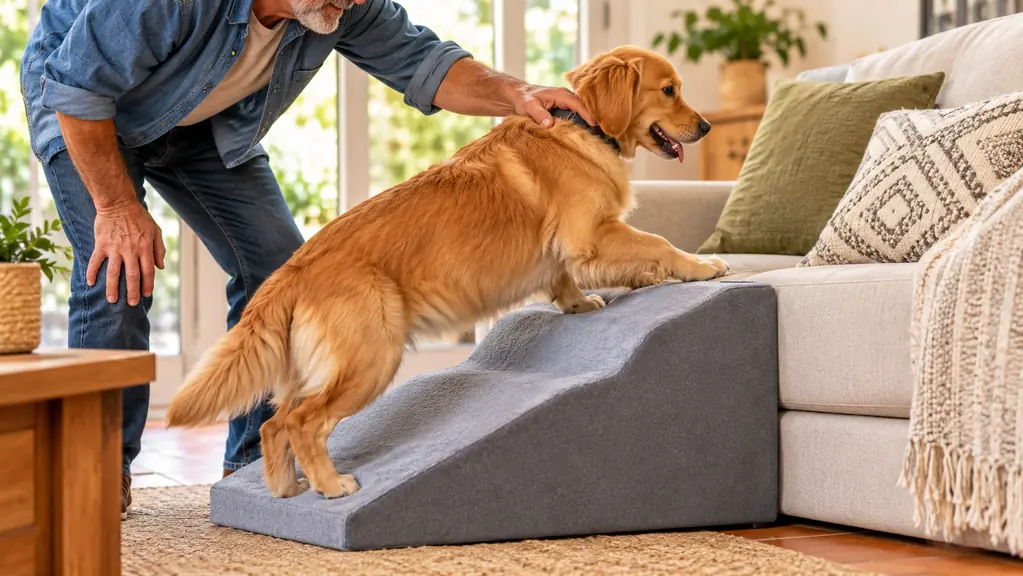
Gus's feet stayed where he put them on the Topmart ramp, and that sounds like a small thing until you understand it is the whole thing. Foam gives slightly under a paw, so a dog who is not sure where his back foot is going gets a little feedback instead of a hard surface with nothing to catch. On the borrowed plastic steps his nails had nothing to hold. I spent 31 years taping ankles and watching kids come back from injuries, and the pattern I trust is simple. A body that slips once starts guarding, and a guarding body moves worse.
Two tiers at 11.8 inches is a gentler rise than a set of steps at the same height, because the ramp portion lets him carry his weight forward instead of straight up. He climbs it the way he walks now, slow and deliberate, and he is not launching himself. He gets on the loveseat in the evening again, which he had stopped doing in October 2024. That is the change I can point to and say I saw it with my own eyes, and one dog is not proof of anything except what one dog did.
It weighs 3.9 pounds, so I move it with one hand when I vacuum the den. It sits flat on the tile and it has not wandered. It meets the 14 inch loveseat without a gap at the top, and a gap at the top is where a dog catches a toe and decides the whole idea is a bad one. It took about a week of treats, up one tier and back down, before Gus used it without me standing there. Now he uses it and I do not think about it, which is the highest compliment I can pay a piece of equipment.
That first week is worth describing because it is where most people give up. I put a treat on the first tier and let him take it standing still, no pressure, three times in a row on a Monday. Tuesday we did the first tier and then the top, and I stood at his shoulder rather than in front of him, because a dog will not commit to a surface with a person crowding the landing. By Thursday he was going up on his own and standing on the top tier looking at the seat. Saturday he got on the loveseat. I did not push him once, and I would tell you if I had.
Where Hard Plastic Pet Stairs Win
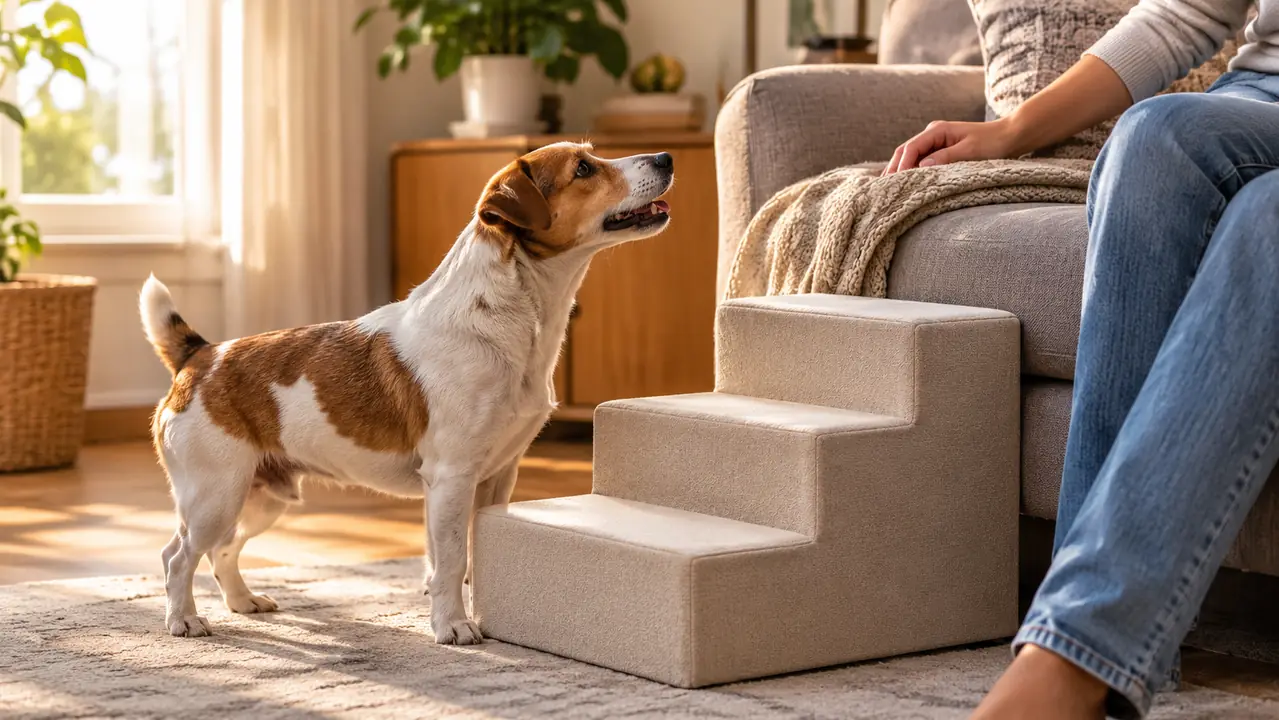
Rigid stairs are built to take more dog. The ramp's 50 pound ceiling, with real comfort under 35, is a limit, and Gus sits close to it. If you have a 70 pound lab, the plastic set is the honest recommendation and I will not pretend otherwise. Stiff plastic does not compress, so a heavy dog does not feel the surface give under a back paw, and some dogs hate that give. Mine does not seem to mind it. Yours might.
Plastic rinses. Our den is carpeted, but the ramp sits near the tile edge where Gus comes in from the yard, so hair and grit collect on the foam and have to be wiped or vacuumed off. A hard plastic set gets hosed down in the yard and comes back inside. If your dog digs, or you live where the ground stays wet half the year, that matters more than a slight give under the paw. East Texas gives us plenty of both, red clay and a wet fall, and my vacuum has the receipts.
One thing I noticed with the borrowed set: on carpet it sat fine, and at the tile edge it rocked a little when Gus put weight on the second step. Nothing dramatic. But between the rock and the slick surface he had two reasons not to trust it, and a dog only needs one. If your floors are hard, set whatever you buy on something that does not move, and check it with your own hand before you ask a 12 year old dog to check it with his hips.
And some dogs simply prefer steps. A dog who has used stairs his whole life will take a step every time and refuse a ramp, and no amount of treat coaching fixes a preference. Plastic also does not tear at the edge or care much about a chewed corner. Ours was borrowed so I cannot speak to how one ages over years, but there is not much to a molded set that can fail.
At 46 pounds, Gus is 11 pounds past the ramp's comfort ceiling. I would rather say that up front than have you find it out at home.
The ramp that got him back on the loveseat in the evenings
Rated to 50 pounds with best comfort under 35, built for furniture 11 to 15 inches high, and 3.9 pounds so you can move it with one hand. Gus is 46 pounds and uses it daily. We knew where the ceiling was before we ordered, and now you do too.
Amazon Check Today's Price on Amazon →Who Should Buy Which
Buy the ramp if your dog is a small or medium breed, roughly 35 pounds and under for daily comfort, or up to 50 pounds with your eyes open the way ours are. Buy it if the furniture you are solving for sits between 11 and 15 inches off the floor. Buy it if your house has tile or hardwood and slipping is the thing you keep watching, because slipping is what the foam addresses. And buy it if your dog has started hesitating at the loveseat or the bed, because hesitation is the earliest sign I know and it is the one people wait too long to act on.
Buy hard plastic pet stairs instead if your dog is over 50 pounds, if you need to wash the thing regularly, or if you want one set you can carry between the bedroom and the living room. Buy them if your dog already takes steps with confidence and just needs a lighter lift than a jump. What I would not do is buy hard steps for a dog who has already slipped on them once. That dog has made up his mind, and in my experience he is usually right. Pay attention to the moment your dog stops offering, because that is the point where the decision stops being about the equipment and starts being about what you owe him.
One more thing, and this is the part I would say at the kitchen table with the coffee going. Ask your vet what your dog's hips and knees will actually tolerate. I am not a veterinarian and I do not play one in the yard. The question I put to Dr. Renner was whether an incline or a step was easier on Gus given where the arthritis sits, and her answer was that either one works if he is not jumping, and that his weight matters more than which one I buy. He is on the joint chew she suggested, we keep him lean, and the ramp is one piece of the picture. It is not the picture.
Measure the seat, weigh the dog, then decide
Three things before you order: check your furniture height against the 11 to 15 inch range, weigh your dog honestly instead of how you remember him, and plan on a week of treats before you call it a failure. The dimensions and today's price are on the listing.
Amazon See the Topmart Ramp on Amazon →