
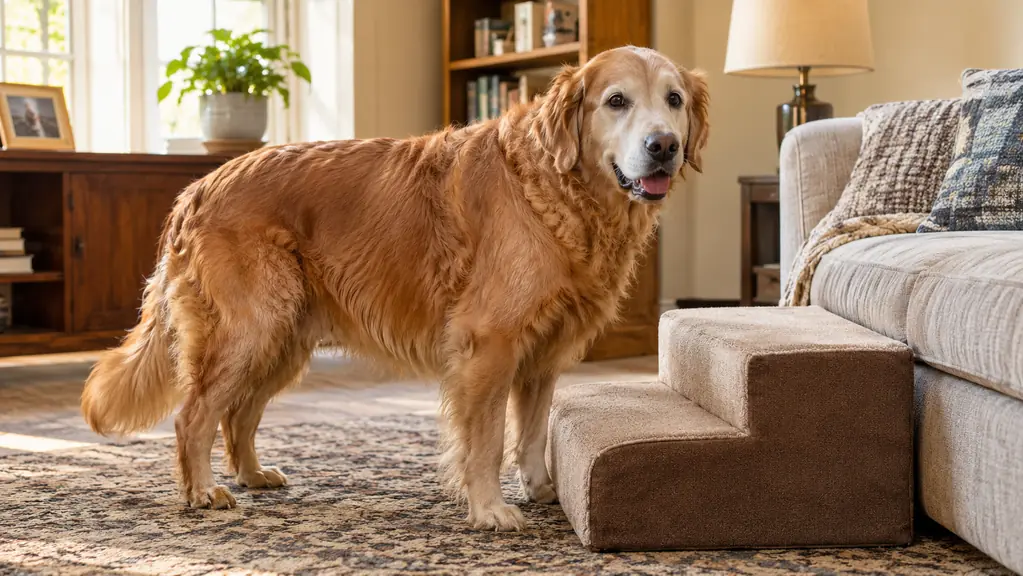
Gus is a twelve-year-old Brittany mix, forty-six pounds, and for most of his life he got onto the loveseat in our den the way he did everything else, which was all at once. Then one evening in June of last year he misjudged it. His front feet found the cushion. His back feet did not, and he slid back down onto the carpet and stood there a moment. I have watched a few thousand teenagers do that exact thing after a bad landing. The body recalculates, and then it pretends nothing happened.
He tried it once more that week and did not commit. That was enough for me. We bought the Topmart foam dog ramp the following week and it has sat beside that loveseat every day since. What follows is a plain account of seventeen months of daily use, including the part I think you should hear before you order, which is that at forty-six pounds Gus is close to the top of what Topmart rates this ramp for.
The Quick Verdict
Worth it for a dog who still wants up and has started thinking twice. Read the weight rating first, because a forty-six pound dog is near the ceiling of it and you can feel the foam working.
Amazon Check Today's Price →For the dog who puts his front feet up, thinks about it, and backs off
Ours has taken this ramp daily since June 2025. Two tiers, 11.8 inches at the top, 3.9 pounds, so it moves with one hand. Check the seat height you are solving for and your dog's weight before you order.
Amazon Check Today's Price on Amazon →How I've Used It
Here is the setup, because it matters more than anything else I can tell you. Our house is one story. There are no indoor stairs, so the only stairs in Gus's day are the three wooden ones off the back porch, and those are a separate problem with a separate answer. The loveseat in the den has a seat height of fourteen inches and sits on carpet. The ramp lives against the front of that loveseat and nowhere else. It has never been on the porch and it has never been in the car.
The first week was training, not use. I put a treat on the bottom tier, then on the top tier, then on the cushion. Gus is food motivated the way most Brittanys are, which is to say completely, and by about day seven he was walking it on his own. What surprised me is that he kept using it after the treats stopped. Dogs are careful about footing. Once he trusted the surface, the ramp stopped being something I had to manage and became furniture.
That is the part I keep coming back to. He does not use it because I want him to. He uses it because going up in two flat moves is easier than one big jump, and he worked that out without anyone explaining it. For a while I stood in the doorway and watched him do it, which is a strange thing to admit about a piece of foam, but the whole reason we bought the thing was to see whether he would choose it on his own.
The wrong jobs are worth naming. If you are looking at this to solve porch steps or to get a dog into a vehicle, look at something else. Loading into the CR-V is a different height and a different kind of work, and a foam ramp sized for furniture does not belong there. One product, one job. That has been the rule in this house since the dogs we have had over the years, every one of them.
What Two Tiers and 11.8 Inches Actually Change
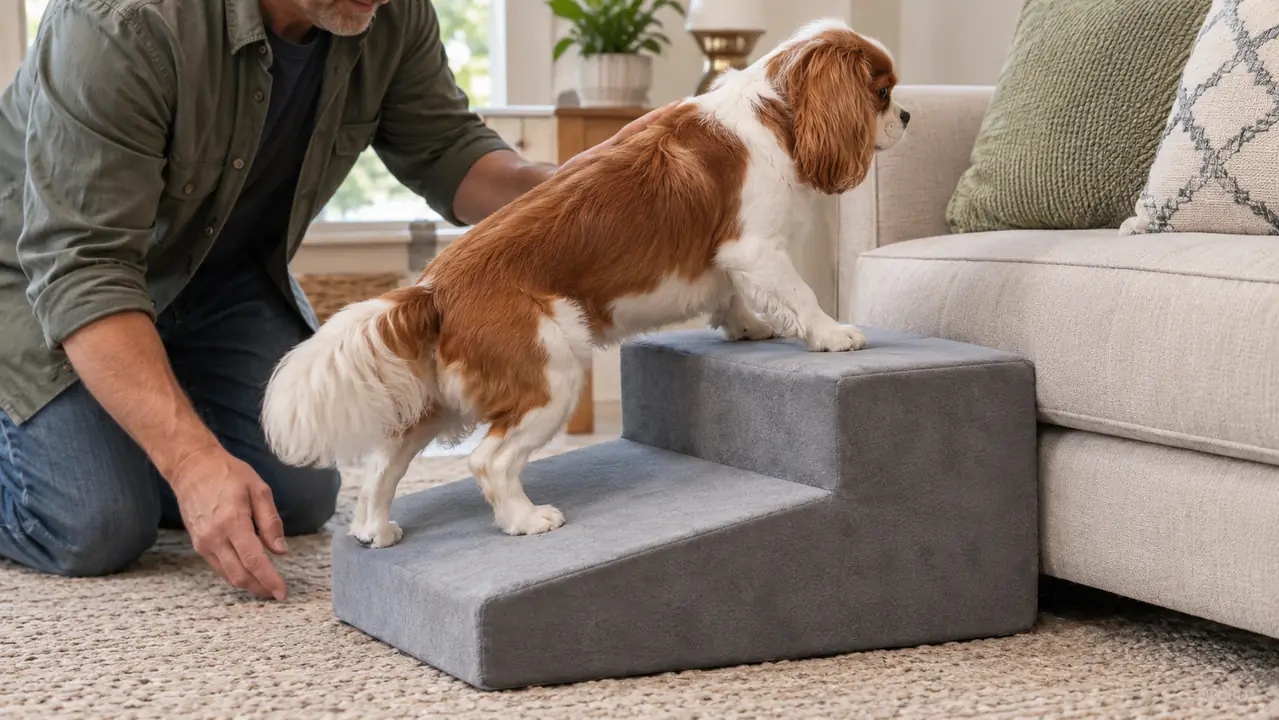
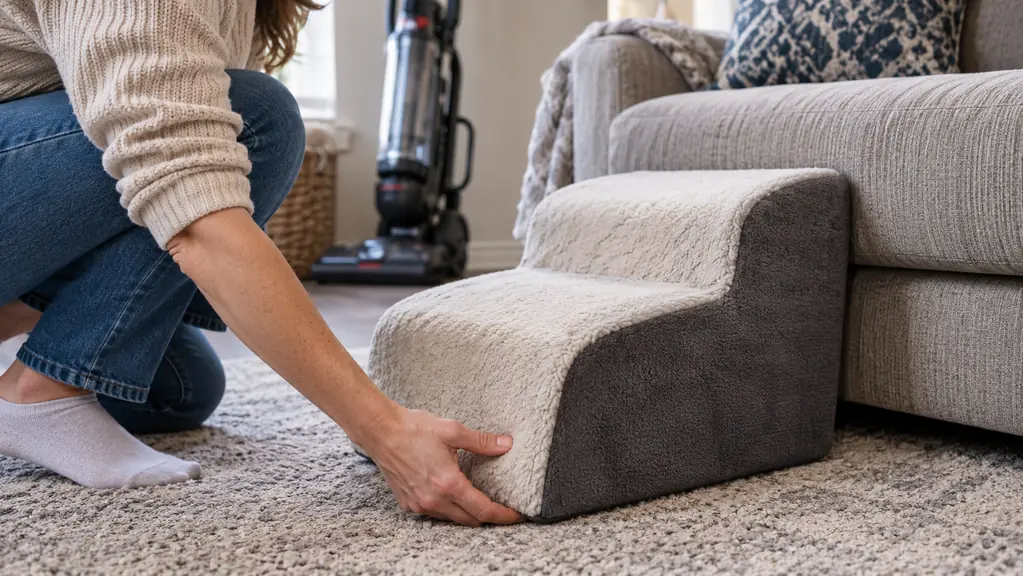
The ramp is two tiers of foam, 11.8 inches at the top, 21.7 inches deep, 15.7 inches wide, and Topmart says it suits furniture between about eleven and fifteen inches. Our fourteen-inch loveseat sits in the middle of that range, which is why the top tier lands flush with the cushion instead of leaving him a small second step to negotiate. It weighs 3.9 pounds. I pick it up with one hand when I run the vacuum and set it back down where it was.
The two tiers are the part I did not expect to care about and now do. A single slope of the same height would be a steeper climb over a shorter run. Two flat steps let him place a foot, shift his weight, and place the other foot, the way a person uses a staircase with a handrail. Thirty-one years of taping ankles taught me that a body is happiest when it can plan the next contact point instead of guessing at it. He goes up in two committed moves and comes down the same way.
Topmart calls the foam 30D high density and makes a point about it resisting yellowing and breakdown. What I can tell you is what a forty-six pound dog does to it over seventeen months. There is a shallow depression in the top tier that springs back when he steps off. The edges have not crumbled and the middle has not gone soft. I have thrown out cheaper foam pet products that turned to powder inside a season. This one has held.
Living With It: The Honest Friction
The ramp is soft, which is the reason I bought it and also the reason it takes a small amount of management. On the den carpet it stays where I put it, mostly. Once every couple of weeks I nudge the base back an inch or two, usually after Gus has come down faster than he went up. Nobody mentions that on a product page. It is a two-second thing and I would rather tell you than have you find it yourself.
The foam compresses under him. At forty-six pounds he is well past the thirty-five pounds where Topmart says this ramp is at its most comfortable, and inside the fifty pound rating. I can see the top tier give when he steps onto it, and I can hear the foam work. Gus does not act bothered by it and he has never hesitated on the way up. But a heavier dog is asking more of this ramp than a lighter one, and that is worth knowing before you order rather than after.
Cleaning is unremarkable, which is exactly what you want. The surface vacuums and spot cleans the way the loveseat does. There is nothing to fold out, nothing to assemble, and no hinge to catch a toe. I have not tried to wash it and would not. It sits against the loveseat and looks like a soft piece of furniture, which is more than I can say for the hard plastic pet stairs we borrowed from a neighbor in May 2025 for one weekend. His feet slipped on those the first time he tried them, and that was the end of that experiment.
What This Ramp Does Not Do
Here is where I have to be careful, because I am not a veterinarian and I am not going to write like one. Dr. Renner looked at Gus's X-rays in November 2024 and told us he has arthritis in both hips, worse on the left. A ramp did not change that and cannot change that. What a ramp changes is one jump, repeated, on and off a piece of furniture, several times a day. That is the entire claim and it is a real one without being a large one.
I have read product pages that imply a ramp will keep a dog mobile and comfortable for years. I would not put it that way. What I can say is that Gus stopped sliding off the loveseat, stopped standing in front of it doing arithmetic, and went back to getting up there in the evenings the way he always had. Everything past that is his vet's department and mine, and mine is mostly keeping his weight where she asked me to keep it.
If your dog is at the point where he does not get on the furniture at all, a ramp on the side of a loveseat solves a problem he no longer has. If he is at the point where he struggles to rise off the floor, a ramp is not the answer and you should be in an exam room rather than on a product page. The question I would ask your vet first is whether the furniture is still reasonable for your dog, or whether a bed on the floor in the same room is the better answer. That answer is worth more than any review, including this one.
What I'd Ask Before You Buy One
Measure the seat height you are solving for. Not the back of the couch, the seat. Ours is fourteen inches and the top of the ramp is 11.8, so the two agree and there is no step up at the end. If your couch seat is nineteen inches, this ramp leaves a jump at the top and you will be writing a different review than mine.
Weigh your dog honestly, and do not round down out of optimism. Topmart rates this to fifty pounds with the best comfort under thirty-five. Gus is forty-six, which is near the ceiling, and I have said so more than once now because it is the single most useful thing I know about this ramp. If your dog is fifty-five pounds, this is the wrong product, and good intentions do not change what foam does under a heavier body.
Decide ahead of time whether your dog will use it. Ours needed about a week and a food motivated disposition. I have known dogs who would not walk on anything that was not floor, and a ramp does not cure that. Put it down, put treats on it, and give it a week. If your dog will not touch it, send it back. That is the practical use of the one year warranty Topmart lists, which is worth having and which I hope never to need.
What I Liked
- Two flat tiers let an older dog place each foot instead of guessing at a slope
- 3.9 pounds, so one hand moves it for vacuuming and sets it back
- High density foam has not crumbled or gone soft in seventeen months of daily use
- Top tier lands flush with a fourteen-inch loveseat, no second step at the end
- Arrives ready to use, nothing to fold out and no hinge to catch a toe
Where It Falls Short
- Rated to 50 pounds with best comfort under 35, so a 46-pound dog sits near the top of it
- Needs nudging back into place on carpet every couple of weeks
- Sized for furniture only, not for porch steps or a vehicle
- Took about a week of treats before our dog used it on his own
A ramp does not touch the arthritis. What it touches is one jump, repeated, on and off the couch, several times a day. That is a smaller claim than most product pages make and a more honest one.
Who This Is For
This is for the household with a dog in the thirty to forty-five pound range who has started hesitating at the couch. The dog who puts his front feet up, thinks about it, and backs off. The dog who used to launch and now climbs. If that is your dog, and your furniture seat is somewhere between eleven and fifteen inches, this ramp fits the problem almost exactly.
The other household it suits is one where a person has been lifting the dog onto the couch for a few months and everybody is tired of it. Forty-six pounds is not a lift I want to do four times an evening, and it is not one I want Mike doing either. The ramp took that job away from both of us, and neither of us has missed it.
It is also for the person who does not want a piece of plastic furniture in the den. It is foam, it is quiet, and it does not clatter when a dog hits it wrong at eleven at night. That mattered more to Mike than it did to me, and I will give him the point.
Who Should Skip It
Skip it if your dog is over about forty-five pounds, and skip it without guilt if he is over fifty. Topmart rates this to fifty with best comfort under thirty-five, and I have now told you more than once that Gus at forty-six is close to the edge of it. There are wider and longer ramps built for bigger dogs and this is not one of them.
Skip it if the furniture you are solving for is taller than fifteen inches at the seat, or if the real problem is the porch steps or getting into the car. And skip it if your dog has stopped getting on the furniture entirely. A ramp is a tool for one narrow job, and that job is a dog who still wants up and has started to think twice about how.
The ramp that ended the two-tries-and-quit at our loveseat
Daily use since June 2025, seventeen months in, still holding its shape and still where I put it. Check the seat height you are solving for and your dog's weight against the rating before you order. If both fit, this is the one I would buy again.
Amazon Check Today's Price on Amazon →