
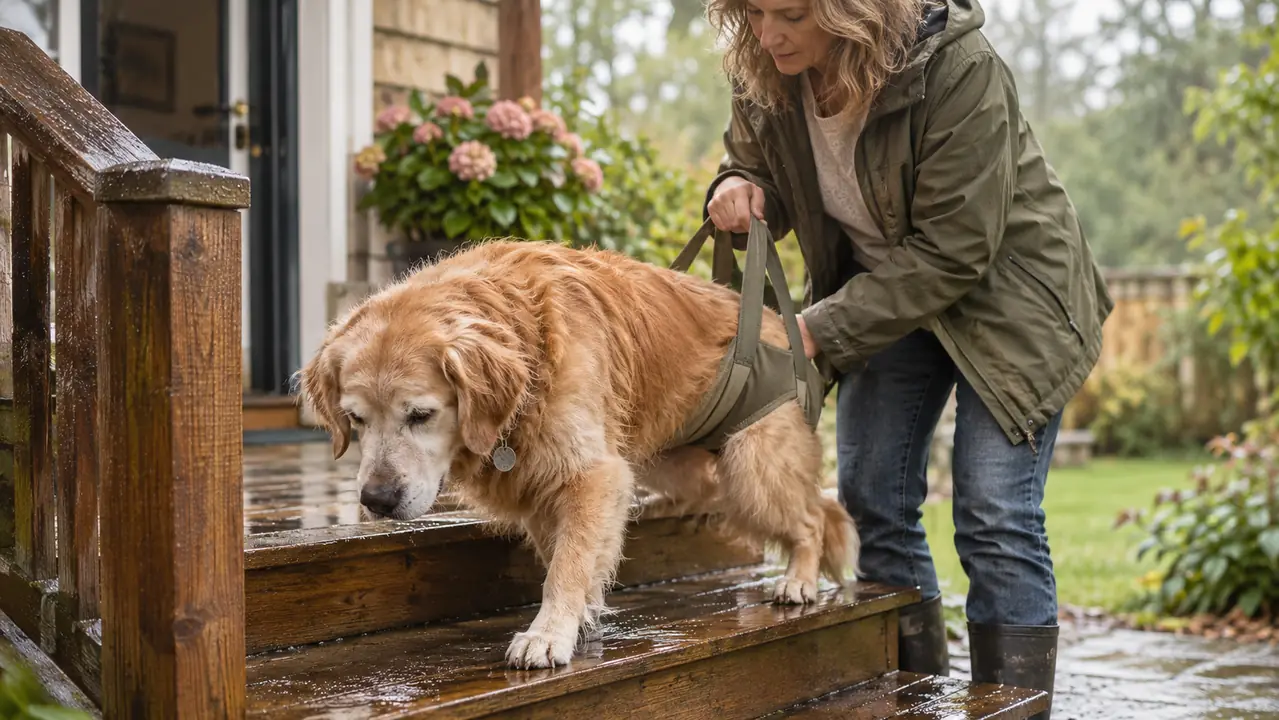
The first time I put the PICK FOR LIFE hind leg support sling on Gus, I got it wrong. I had a strap twisted, I was standing too far behind him, and he turned his head around to look at me with the flat expression a dog gets when he has decided the humans have lost their minds. That was February 2026, a week after a wet morning when his back legs slid out from under him on our porch steps. He was not hurt. He got up and shook himself off. But I stood in the rain with my coffee going cold and thought about all the years I spent taping ankles for kids who could tell me exactly where it hurt.
Gus is a twelve-year-old Brittany mix, forty-six pounds, and he has arthritis in both hips, worse on the left. Dr. Renner found it on X-rays in November 2024. She suggested the joint chew, asked us to keep his weight down, and said we would talk about prescription pain medication down the road. Nobody at that appointment said the word sling. I went looking for one myself four months later, because I had watched him slide on the same three wooden steps twice in one week and I did not want to be the person who waited for the fall that did the damage.
The Quick Verdict
A well-made nylon lifting sling that does exactly one job: it takes weight off the back end for a few seconds at a time. It is not a harness, not a walking aid, and not a fix. For a forty-six pound dog on three porch steps, ours earns its hook by the back door.
Amazon Check Today's Price →8.8 Ounces That Changed How Our Wet Mornings Go
The PICK FOR LIFE sling is a nylon lifting strap with a padded handle, a storage bag and a guide. It is not a harness and it will not walk your dog for you. It is the thing I reach for when the porch steps are slick.
Amazon Check Today's Price on Amazon →What Arrived, and What It Is Not
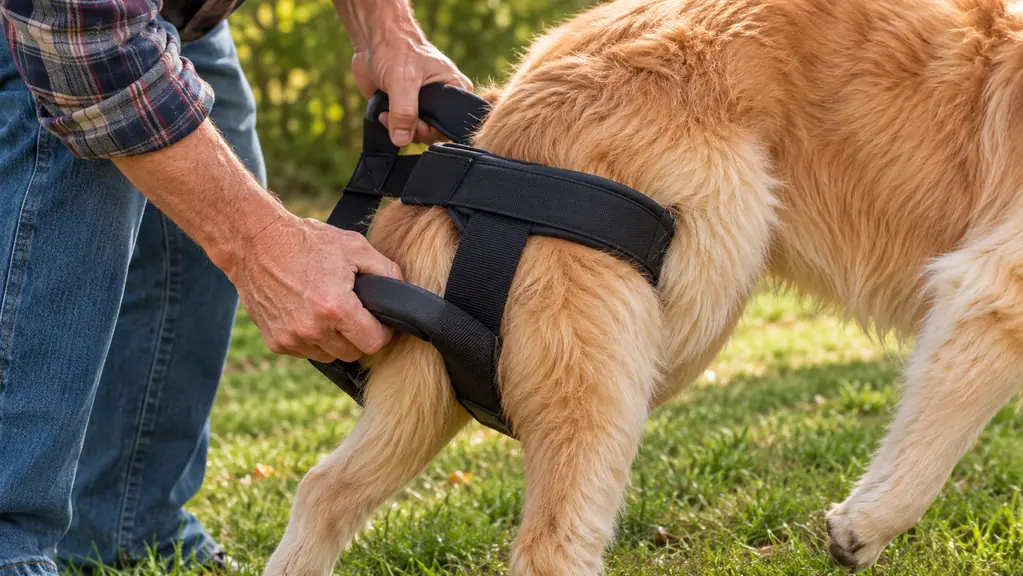
The package is small. Inside it: the sling, a padded handle, a storage bag and a user guide, the whole lot weighing 8.8 ounces in a package that measures 9.11 by 6.67 by 3.85 inches. What you are getting is a length of nylon webbing that passes under the dog's belly just in front of the hind legs, with straps that adjust and a drawstring closure, plus the handle you hold while the dog walks. That is the entire product. There is no frame, there are no wheels, and it does not touch the front of the dog at all.
I want to be plain about the naming, because the PICK FOR LIFE listing title is doing a lot of work. It calls itself a sling, a harness and a mobility aid inside a dozen words. It is a lifting sling. A true harness wraps the chest and takes weight off the whole body, and this does not. Size Large is what we ordered, and the listing does not state a weight range for it, which is a real gap for anyone standing in their kitchen trying to guess.
One more thing about what arrives, because it matters for the first week. The user guide is short, and it assumes you already understand where the strap is meant to sit. I laid the whole thing out on the kitchen counter on a Sunday afternoon and read the guide twice before I took it anywhere near the dog. That was the right call. If you can, do your learning inside on a dry floor with a patient dog and no audience, because the porch on a wet Tuesday is no place to be figuring out which strap goes where.
How I've Used It Since February
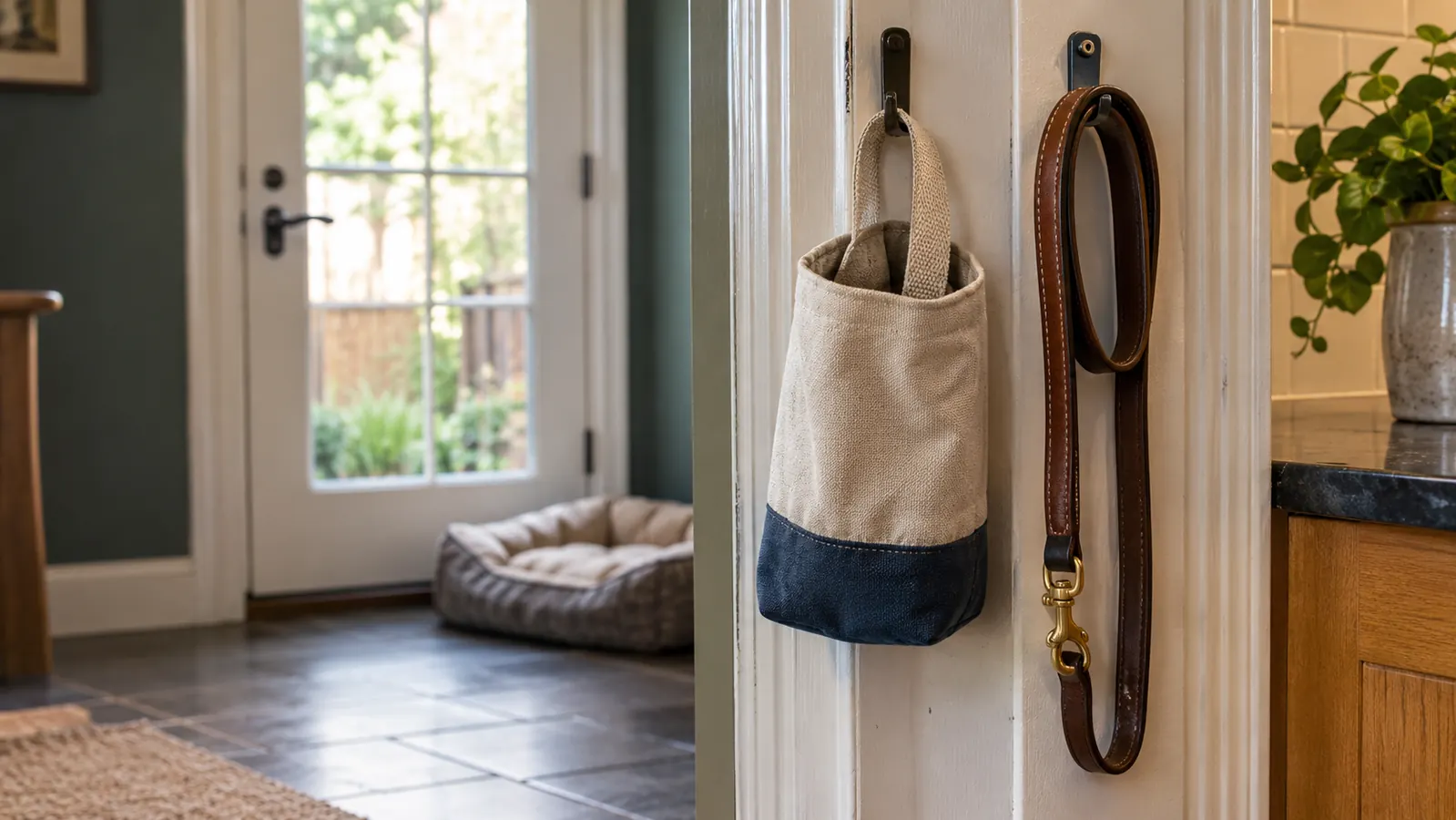
It hangs in its storage bag on a hook by the back door, next to the leash. It is not part of our daily routine and I will not pretend otherwise. It comes out on wet mornings, on the mornings after a long walk when he is stiff, and for getting in and out of the CR-V. Call it two or three times a week. Mike or I stand beside and slightly behind him, hold the handle, and lift just enough that his back feet are doing less than they were doing a second earlier.
The porch is the main event. Three wooden steps down to the yard, and when they are wet they are the slickest thing on the property. Before February I would walk down ahead of him and turn around and watch, which is a useless thing to do. Now I am beside him with a hand on the handle and we go down together at his pace, which is slow, and he does not slide.
The car is the second place it earns its keep. Gus rides in the back seat of the CR-V. Getting in has never been the problem. Getting out is where he stands at the edge and thinks about it, back legs gathered under him, and you can see him deciding. The sling goes under him, I take the weight, and he steps down. Eight seconds, maybe ten. That is the whole transaction.
There is one morning I keep coming back to. It was a Thursday in March and it had rained all night and the boards were still beaded with water at seven. Gus came out of the door before I had the sling fully open, which he does, because he is twelve and he has his own ideas about scheduling, and he put one back foot on the top step and it went out from under him sideways. I got the strap under him on the second step. That is the difference a hook by the door makes. It is not that the sling is clever. It is that it is close enough to reach before he reaches the stairs.
One thing thirty-one years of taping ankles taught me, and this product makes obvious: your own body is part of the equipment. Keep your back straight, bend your knees, stand close. If you hold the handle at arm's length and lean away, you will be the one in a doctor's office. The straps adjust so you can get the handle to a height that suits you, but the adjustment has limits, and if you are tall and your dog is short you will feel it in your low back by the third trip of the morning. Mike is sixty-three and six inches taller than I am, and he holds the handle lower than I do and stands a step closer to the door. We have both found what works, and it took a couple of weeks to get there.
It is not a wheelchair and it is not a cure. It buys him eight seconds on a wet step, and eight seconds is exactly where the injury was going to happen.
What Nobody Tells You Before You Buy One
The first thing nobody says out loud: this supports the back end only. If your dog's problem is in the front, or if he is at the point where he needs support front and back, a sling is the wrong tool and you will know it the first time you use it. I looked at a full body harness once, at Dr. Renner's office, and I have never owned one. For where Gus is right now, hind end only is the job.
The second thing: the dog has to agree to it. The first three times I put it under Gus he braced, which is what a dog does when something new touches his belly. I did short sessions. On, a piece of chicken, off. Then on, chicken, three steps, off. It took most of a week before he stopped flinching. Some dogs never get there, and no amount of technique fixes a dog who has decided he hates it.
I should say how badly that week started, because reviews that skip the bad part are the reason I stopped reading them. The first attempt was in the kitchen on a Monday, on tile, which was a mistake before I even began, because his feet were already unsure and now I was adding a strap to the situation. He sat down. He sat down and looked at the ceiling and refused to move, and I stood there holding a handle attached to a sitting dog and laughed, because what else is there. Tuesday we went outside on the grass. Grass gives him something to push against. That was the change. By Thursday he would take the chicken and walk a few steps for it, and by the following Monday he walked out the back door with the strap in place without any nonsense at all.
The third: it is a transfer tool, not a walking aid. I have read reviews where people describe long walks with a sling in place, and good for them, but that is not what this is for in our house. The webbing is meant to take weight for seconds, at a doorway, at a step, at the edge of a car seat. If you need to support a dog for a mile, you want something with more structure than a strap and a handle.
The fourth: the warranty. The listing says seven days. Seven. That is not a warranty so much as a window to find a stitching flaw. Open it the day it arrives, run your thumb along every seam, put it under the dog, and if something is wrong, say so immediately. Ours was fine out of the bag and has been fine since February, but I would not count on a replacement in March.
The fifth: it is machine washable, and it will need washing. A sling that goes under a dog's belly and then hangs by a door picks up everything. Ours goes through the wash about once a month and comes out the same shape, which is more than I can say for some of the tape I used to keep in my training bag.
The Towel Under the Belly, and Why We Stopped
Before there was a sling there was a towel, which is what most people reach for first. You fold a bath towel lengthwise, pass it under the belly in front of the hind legs, and hold both ends like a stretcher. It works. It is also miserable on your hands after about a week, because a towel has no handle and no seam, and the whole load sits in the crook of your fingers. We did it for maybe ten days in January and my hands complained more than my back did. The other problem with a towel is that it will not stay put. You get it positioned, you take a step, and the fabric rolls and shifts and you are back to adjusting with a dog standing on a wet step waiting on you. Mine had a seam down the middle that kept wanting to sit right where I needed the flat of the fabric, and I finally gave up on that particular towel.
What the sling changes is not the idea, it is the grip. The padded handle is the entire upgrade. Same physics, same under-the-belly position, but the load lands in your palm instead of cutting across your knuckles, and the strap stays where you set it instead of bunching up. If you have been doing the towel trick and it is wearing you out, that is the honest case for spending money here. Not because a towel fails, but because a towel is a tool for one afternoon and this is a tool for a year.
One caution if you are moving up from a towel. Reduce how much you lift the first few days. A towel gives you a soft, ragged grip that teaches your hands to pull more than they need to. With a real handle the load transfers cleanly and it is easy to overdo it, especially if your dog is heavy, and the last thing you want is to be sore the second morning and start skipping the very routine you built.
Where It Fell Short For Us
The honest complaint is the fumbling. Setting the straps right takes two hands, and the morning it matters most is the morning you are holding a coffee in one of them. I have learned to set it before I go out, standing in the kitchen, and carry it out already open. That is a workaround, not a design flaw exactly, but nobody mentions that the product is at its most awkward when the weather is at its worst.
Size is the second complaint, and it is aimed at the listing more than the product. Large is generous on a forty-six pound dog. There is a fair amount of strap tail hanging once it is adjusted down, and because no weight range is given for the size, I bought on a guess. If your dog is closer to thirty pounds, I would look hard at whether Large is right before ordering, and I would ask the seller directly rather than assume.
The third thing, and this is not the sling's fault: it does nothing about the loveseat. Our den has a low loveseat, fourteen inches at the seat, and Gus stopped hopping onto it in the fall of 2024. The sling is not the answer there. That was a separate purchase, a foam ramp, and the two products do not overlap at all. Neither one does the other's job, and I think that is exactly right.
And it does nothing about the kitchen tile. Our kitchen is tile, and Gus scrambles when he turns too fast on it, and a sling cannot fix traction. That is a rug problem, not a lifting problem.
What I Liked
- Takes real weight off the hind end for steps, doorways and car transfers
- 8.8 ounces, folds into its own storage bag, hangs flat by the door
- Padded handle is comfortable on your hand through a slow descent
- Straps adjust, and the whole sling is machine washable
- Simpler and less fuss than a full body harness for a dog who only needs the back end
Where It Falls Short
- The listing gives no weight range for Size Large, so fit is guesswork
- Straps take two hands to set right, which is awkward in the rain
- Seven-day warranty is very short
- Does nothing for the front end and nothing for traction on slick floors
- Only as good as your dog's willingness to tolerate something under his belly
What I Would Ask Your Vet
I am not a veterinarian. I was an athletic trainer for thirty-one years, which means I spent three decades watching people move, deciding when to tape something, and sending them to somebody with more letters after their name when it was past my pay grade. Same rule here. Ask your vet whether hind-end support is even the right help for your dog, because it is not the right help for every dog. Ask what the front end is doing. Ask about weight. Ask whether a full body harness or a cart is a better fit for where your dog actually is.
The single most useful thing Dr. Renner does at our visits is watch Gus walk. Not the exam table. The parking lot, from a distance, while she is talking about something else. If your vet does that, ten seconds of watching will tell you more about whether a sling helps than any amount of reading, including this. If you have already bought one, bring it to the appointment and ask them to watch you use it, because technique is where most people get this wrong before the product ever does.
There is a cheap version of that test you can run at home tonight, and it costs nothing. Walk your dog slowly across the den and watch the back feet. Not the face, not the tail, the feet. Does one turn out. Does one drag. Does he shorten his stride on the left. That is the same thing I used to do in a gym with a kid who swore his ankle was fine, and it is the same thing that made me notice Gus was not fine in October 2024, weeks before I did anything about it. Write down what you see and take the note to the appointment. A vet who gets a specific description will get further in ten minutes than one working from the word stiff.
Who This Is For
This is for the household with a big dog whose back end has started to lag. The dog who still walks, still wants the walk, and needs a hand on the stairs and at the car. The one who is not ready for wheels and may never be. If you are already lifting your dog's back half up the steps with a towel under his belly, this is that towel with a handle and a proper seam, and it will be easier on your hands and your back.
Who Should Skip It
Skip it if the problem is the front end, or if your dog needs support front and back, because this will not do it. Skip it if your dog will not tolerate anything under his belly, because no sling works on a dog who braces. Skip it if you were hoping it would help on slick floors, since that is a rug question. And skip it if you want one tool for everything, because the honest answer is that this is one tool for two jobs: the back porch steps and the back seat of the car.
One Job, Done Properly, for the Wet Mornings
The PICK FOR LIFE sling is 8.8 ounces of nylon with a padded handle, a storage bag and a user guide. It comes out two or three times a week in our house and it does not pretend to be anything else.
Amazon Check Today's Price on Amazon →