
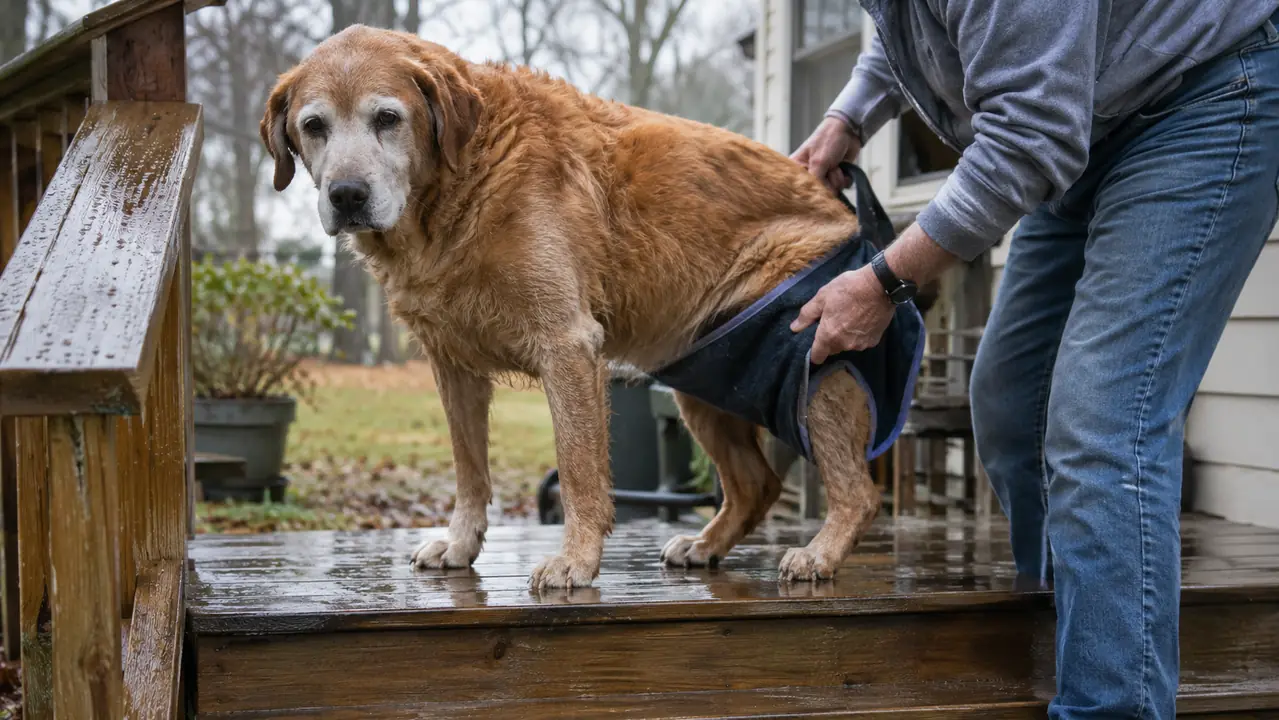
The first time I saw Gus's back legs slide out from under him, it was a wet Tuesday morning in February 2026, and he was coming down the three wooden steps off our back porch. He is a 12-year-old Brittany mix, 46 pounds, with arthritis in both hips, worse on the left, seen on X-rays at Dr. Renner's office in November 2024. He was not hurt that morning. But I had spent 31 years as a high school athletic trainer, taping ankles and watching how teenagers moved, and I knew what I was seeing. His back end had stopped trusting the ground. We bought the PICK FOR LIFE Hind Leg Support Sling that week. It hangs in its storage bag on a hook by the back door now. This is not a review of a harness I own. It is a comparison I wish I had read before I stood in Dr. Renner's office, looking at a full-body support harness and wondering if I had bought the wrong thing.
Here is the short answer. If your dog needs a light lift at the back end for a few steps or getting into the car, the PICK FOR LIFE sling is the simpler tool. If your dog needs support through the chest and belly, or you are lifting for longer stretches, a full-body support harness is the better shape. I use the sling two or three times a week, on rainy days, bad mornings, and the back seat of our Honda CR-V. I have not owned a full-body harness. I looked at one at Dr. Renner's office and asked her what she would use for what. That conversation is most of what follows. I am not a veterinarian. I am a woman with one dog, a wet porch, and a low loveseat in the den.
| PICK FOR LIFE Hind Leg Support Sling | Full-body support harness | |
|---|---|---|
| What it supports | The rear end, under the hindquarters, with a padded handle for a light lift. | The torso and hindquarters, with more contact across the body. |
| Time to put on | Slides under the back end and the handle comes up. Quick for a porch step. | More straps and fitting. Slower for a two-minute job. |
| Best job | Three porch steps, into the CR-V, a stiff morning after a walk. | Longer transfers, a dog who needs chest or belly support, rehab work with a vet. |
| Bulk and storage | 8.8 ounces, comes with a storage bag, hangs on a hook by the door. | More material and straps, takes more room to keep handy. |
| Adjustability | Adjustable, sized Large, drawstring closure. | More adjustment points through the torso. |
| Cleaning | Nylon, machine wash. | Varies by harness. Check the label. |
| Support for a dog who leans | You lift at the back end. The dog still carries the front. | The harness carries more of the body. |
| Learning curve for the dog | One handle, one job. Gus accepted it in one morning. | More fitting and more straps. Some dogs need treats and patience. |
Where the PICK FOR LIFE Sling Wins
The PICK FOR LIFE sling wins on speed, and speed is not a small thing when a dog is standing on wet steps. The sling is 8.8 ounces. It comes with a storage bag. Ours hangs on a hook by the back door, and I can have it under Gus's back end before he has time to sit down and decide he is not going out. The handle is padded. The material is nylon, and it is machine washable, which matters because our back porch is not clean and February is not dry. I have washed it on a Saturday and had it back on the hook by Sunday. That is the whole reason it gets used. A tool that lives in a closet does not help a dog who needs a hand on a Tuesday morning. The sling is sized Large, and it is adjustable, so it fits the job we have.
The morning that sold me came three weeks after we bought it, in early March. Rain had been coming down since before daylight and the third step was slick as a gym floor after a pep rally. I slid the sling under him, took the padded handle, and we went down one step at a time, my hand carrying maybe five pounds of him. He got to the gravel and shook off and went to sniff the fence line. Without it I would have been carrying 46 pounds of dog at six in the morning with a 60-year-old back, and that is how a person gets hurt and a dog stops getting outside.
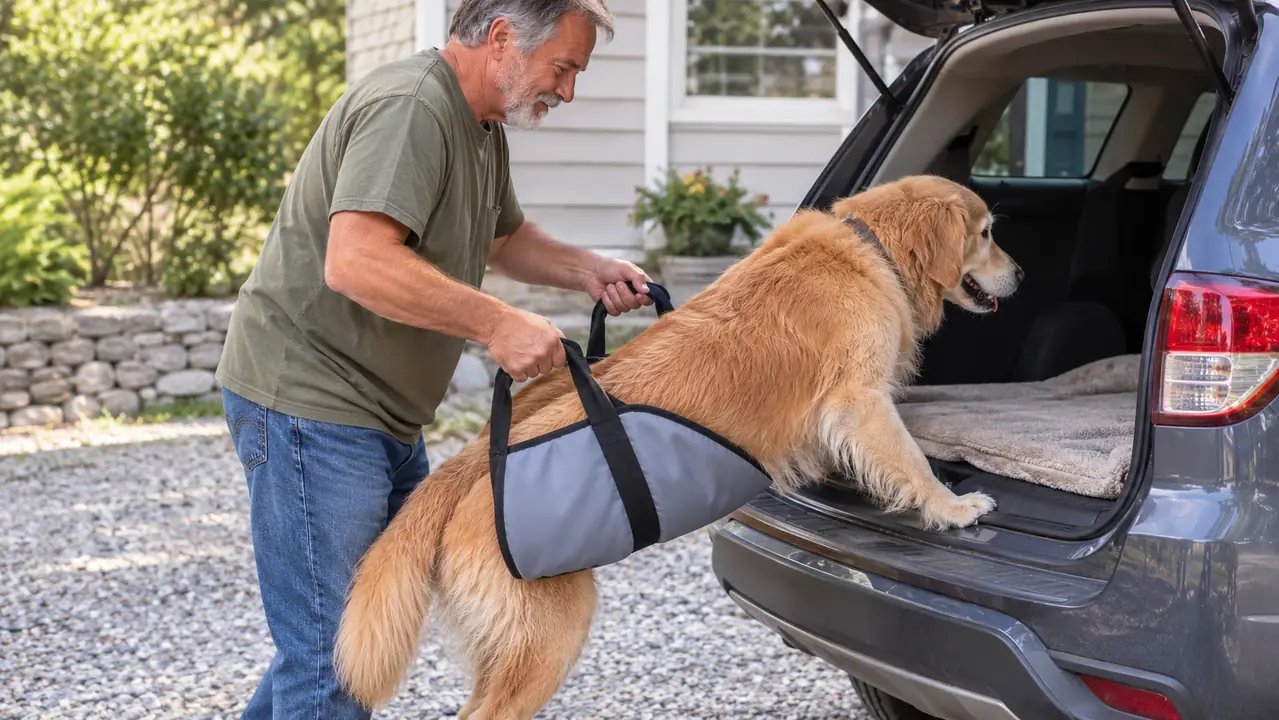
The sling also wins because it asks for a narrow job and does it. Three wooden steps. The back seat of the CR-V. A bad morning after his walk when he is stiff. Mike or I lift lightly at the back end while Gus walks. He still carries his front. That is the point. For a dog whose problem is mostly the back end, a full-body harness can be more equipment than the job needs. More straps mean more places to check, more places for a dog to feel restricted, and more time on the porch in the rain. I am not against equipment. I spent 31 years wrapping ankles. But I believe in using the smallest tool that does the job. For Gus, on those three steps, the smallest tool is the PICK FOR LIFE sling.
We tried a cheaper answer first, and it did not work. Back in May 2025 we borrowed a neighbor's hard plastic pet stairs for a weekend, thinking Gus could walk himself up to the loveseat, and his feet slipped on the treads the first time he tried. That loveseat sits 14 inches off the floor. It is a different job than the porch steps, and we ended up with a foam ramp beside it instead. The lesson held: ask what the specific job is before you spend anything. The sling's job is the back end on wet ground.
The sling is not for long walks, and I do not ask it to be. Gus still walks every day, shorter than he used to, and the sling stays on the hook for most of it. It comes out for the back steps, the car, and the kind of morning when his back legs are slow to answer. If I tried to use it as a walking aid for a mile, I would be holding him up instead of helping him, and that is not good for either of us. A tool earns its place by doing one job well. This one does the short lift at the back end. That is why it is still by the door after nine months.
Where a Full-Body Support Harness Wins
A full-body support harness wins when the dog needs more than the back end. It puts contact across the torso and hindquarters. If Gus had needed help through his chest or belly, or if I had been lifting for longer than a few seconds, I would have looked harder at one. The one I saw at Dr. Renner's office had more straps and more places to adjust than our sling. That is not a flaw. It is the shape of the tool. A harness is built to take weight through the body, and a sling is built to take weight at the back end. When the problem is the whole body, the harness is the more honest choice. I would not pretend a rear sling can do a full-body job.
I looked at that harness in January 2026, a month before the rainy morning that sent us shopping. It had a strap that ran under the belly and another that came across the chest, and the woman at the front desk said they use that style for dogs coming back from surgery. I put my hands where the straps would sit on Gus and tried to picture fitting it on him in the rain on our porch at six in the morning, with him shifting his weight and me holding a leash. I could not picture it. That is not a knock on the harness. It is a knock on my patience before coffee.
The harness also wins on longer transfers and for a dog who leans. A sling leaves the front end to the dog. That is fine when the front end is strong. It is not fine when a dog is weak through the chest or when he lists to one side and needs to be held steady. A full-body harness gives you more contact and more control through a longer lift, such as a car transfer for a dog who cannot steady himself, or a walk from the house to the yard on a bad day. It takes more time to put on and more room to store. That is the trade. If I were lifting Gus for ten minutes instead of ten seconds, I would want the harness, not the sling. The right tool depends on the length of the job.
A full-body harness is not a fix for a dog who cannot walk, and it is not a substitute for a vet's plan. It is a way to spread support across more of the body while you do a specific job. That job might be a car transfer, a rehab exercise, or a short walk on a bad day. If you are looking at a harness, ask how it fits through the chest and shoulders, where the straps sit, and whether your dog can still relieve himself without the straps in the way. Those are not small questions. A harness that is hard to put on or that rubs will not get used, no matter how much support it offers.
The sling does not make Gus younger. It gets him down three wet steps without his back legs sliding out, and that is the whole job.
For the dog who only needs a hand at the back end
The PICK FOR LIFE sling is the tool that hangs by our back door. It is 8.8 ounces, it comes with a storage bag, and it is built for a light lift at the hindquarters. If that is your dog's job, start here.
Amazon See the PICK FOR LIFE Sling on Amazon →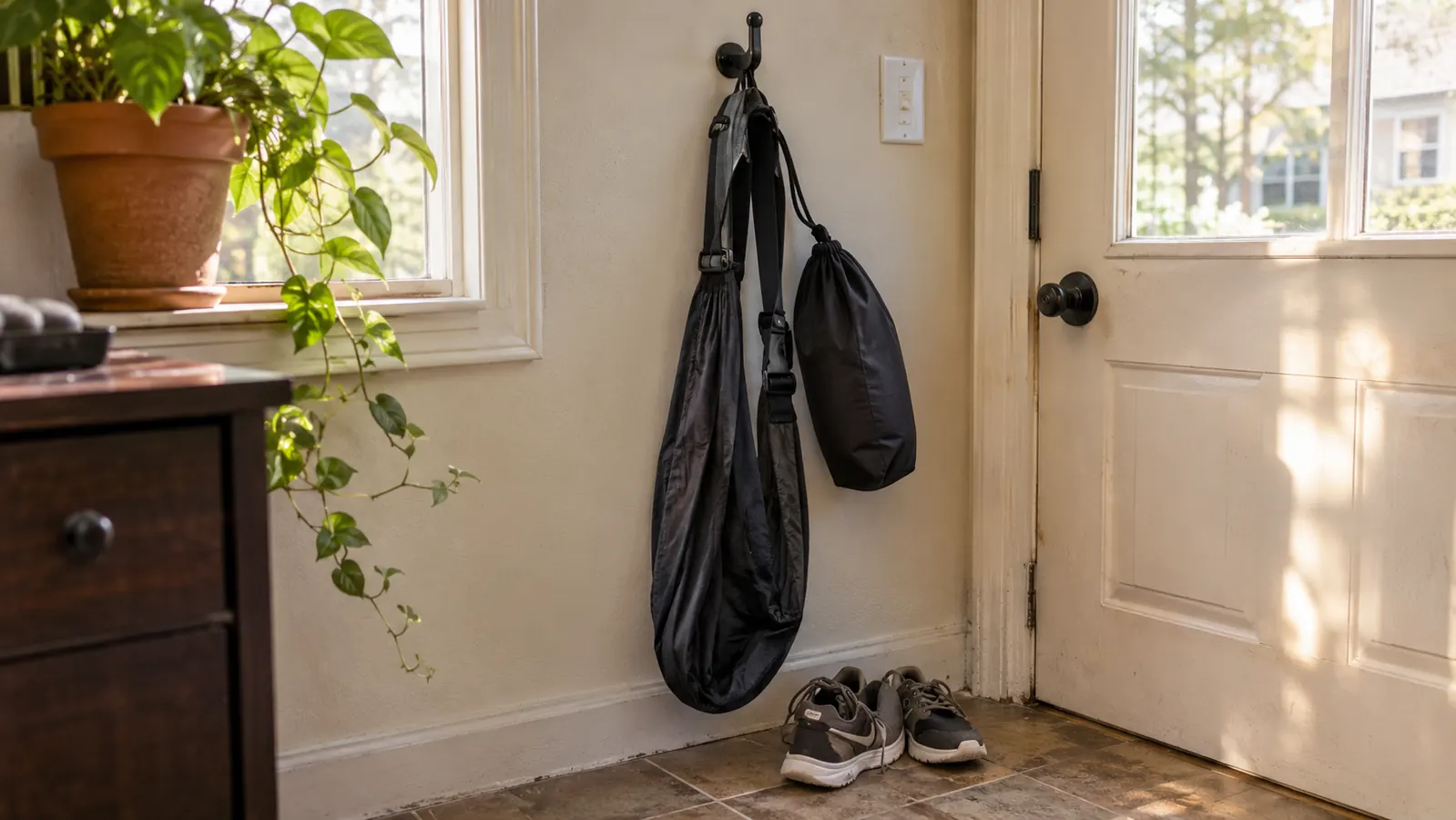
Who Should Buy Which
Buy the PICK FOR LIFE sling if the problem is mostly the back end and the job is short. Your dog can still use his front legs. He needs help on three porch steps, into the car, or up from a stiff morning. You want something that hangs by the door and goes on in seconds. You are willing to lift lightly and let the dog do the walking. That is our house. Gus is 46 pounds, and the sling is sized Large. It is not a wheelchair and it is not a full-body harness. It is a hand at the back end. If that describes your dog, the sling is the place I would start.
One more thing about the car, because it comes up more than the porch does. Gus rides in the back seat of our Honda CR-V, and that seat sits higher off the gravel than the porch steps do. Most days he gets in on his own. On a bad day he puts his front paws up on the sill and stops, and I can see him deciding. That is a two-second lift with the sling, one hand on the handle and the other steadying his shoulder. I would not want to be fitting a harness in a gravel driveway in the dark. If your dog needs the car twice a week, a sling in a bag is enough. If it is twice a day, the math changes.
Buy a full-body support harness if the problem is the whole body or the lift is longer. Your dog needs support through the chest or belly. He leans. He needs to be held steady for a longer transfer. Your vet has asked you to support him through a rehab exercise. You have a dog who cannot carry his front end reliably. In that case, a sling at the back end is the wrong shape for the job, no matter how well made it is. I would ask Dr. Renner before I bought either one. She knows Gus's hips and his weight and what he does on a bad day. I know my porch.
Whichever you choose, I would watch three things. Put the support under the dog before he starts to sink, not after. Lift with your legs and keep the handle close to your body. Keep the job short. The PICK FOR LIFE sling is 8.8 ounces and Gus is 46 pounds, so the tool is not doing the work by itself. It is a help, and I am the other half of it. I do not use it to make him walk farther than he should. A support tool is not a way to override a dog who is telling you he is done.
I would also ask Dr. Renner three questions. Where does my dog need support, at the back end only or through the body? How long will I be lifting him, a few seconds on the steps or several minutes across a parking lot? And what should I watch for after we use it, stiffness, soreness, a change in how he walks? I would ask whether a full-body harness is safer for my dog's specific hips and shoulders. I am not a veterinarian. I can tell you what worked on my porch, with one dog, and that is not proof. Dr. Renner can tell you what is happening inside your dog.
If the back end is the problem, this is the place to start
The PICK FOR LIFE sling is not a full-body harness. It is a light lift at the hindquarters for the short jobs: the porch steps, the car, a bad morning. That is what it does in our house, two or three times a week. Ask your vet which shape your dog needs.
Amazon See the PICK FOR LIFE Sling on Amazon →