
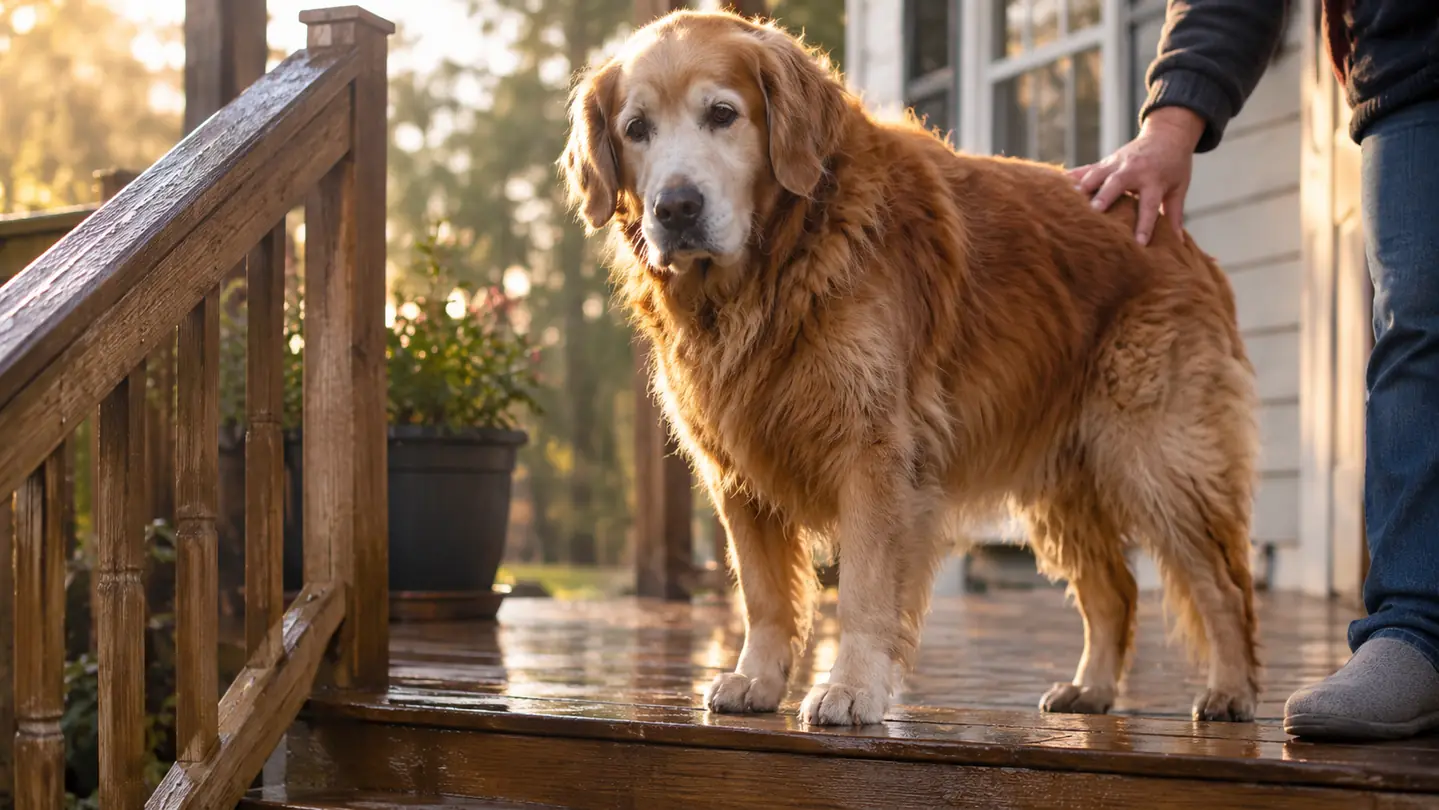
The first time you see it, it does not look like a problem. Your dog pushes up off his bed a beat slower than he used to. He takes the three back porch steps one at a time instead of two. He stands at the bottom of the loveseat, thinks about it, and lies down on the rug instead. You tell yourself he is twelve and twelve is allowed to be slow. That was October for us, with a brown and white Brittany mix named Gus who weighed forty-six pounds and had started to stop and consider before every climb.
I am not a veterinarian. I spent thirty-one years as a high school athletic trainer, and the habit that stuck is this: watch how the body moves before you decide what to do about it. What I saw in Gus was that his back end had started doing the deciding. So the tool this piece is about is a hind-leg sling, and ours is a PICK FOR LIFE sling, bought in February 2026, kept in its storage bag on a hook by the back door.
It helps to know which end you are dealing with. A dog who is slow to rise, who sways once he is up, or whose back feet knuckle over is telling you about his rear. A dog who stumbles on turns or drags a front paw is telling you something else, and a sling under the hindquarters will not help that dog at all. Watch him from behind on a normal walk down the hallway. If his back legs cross under him, or if his hips drop as he goes, you are in the right article.
Before the sling, I tried the things people try. A bath towel folded under his belly slid out of my grip and bunched against his ribs. Lifting him with both hands under his hips worked for about four seconds and left my lower back complaining for two days. We borrowed a neighbor's hard plastic pet stairs for a weekend in May 2025 and his feet slipped on every step. None of that is a knock on towels or on plastic stairs. It is a knock on asking one thing to do a job it was not built for.
What hangs by our back door and comes out on wet mornings
A hind-leg sling is not a fix and it is not a cure. It is nylon, a padded handle, and a storage bag, and on three wet porch steps it is the difference between our dog going out and our dog staying in. That is the whole pitch.
Amazon Check Today's Price on Amazon →Step 1: Have his back end looked at before you buy anything
A sling supports a dog. It does not tell you why he needs supporting. Gus saw Dr. Renner in November 2024, and the X-rays showed arthritis in both hips, worse on the left. That is the sentence I would want you to have before you spend anything: a reason, in plain words, for what you are propping up.
Dr. Renner asked us to keep his weight down and suggested a joint chew at breakfast. She also raised prescription pain medication as something to revisit later, which is where it still sits. Gus is not on it. She did not hand us a sling that day, and we did not ask. We got there sixteen months later on our own, after a wet morning, and I think that delay is worth naming.
If your dog is dragging a back foot, knuckling over, or flinching when you put a hand on his hip, that is a vet visit and not a shopping trip. Ask what movement you are protecting, which direction is hardest for him, and whether lifting his rear end is safe for his particular hips. Write the answers down. You will not remember them from the parking lot.
One more thing about expectations. A sling does not make a dog stronger and it does not slow anything down. It changes what happens in the ten seconds when his back end would otherwise make the decision for him. If you are looking for the thing that fixes the hips, this is not that thing, and nothing on a hook by a door is.
Step 2: Put it under the hindquarters, where the legs do the work
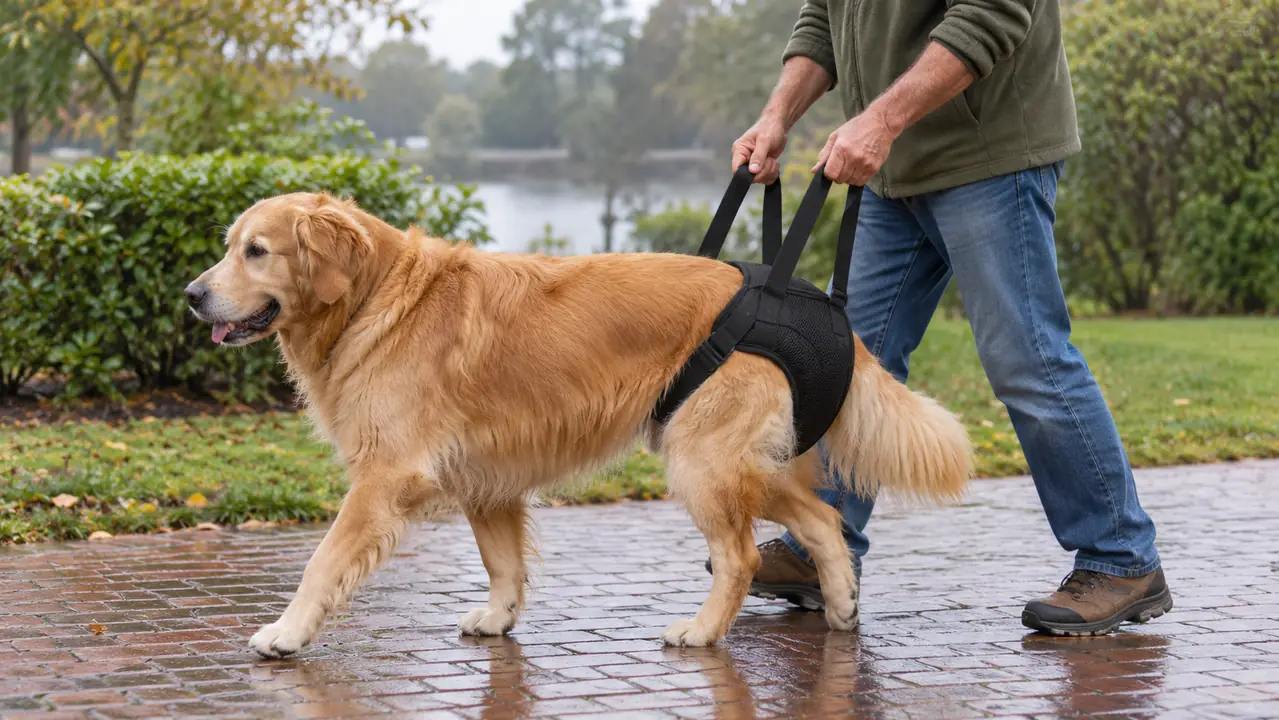
The sling goes under the rear end, ahead of the back legs, not around the belly. A strap across the middle of a dog gives you a handle on his waist, and his waist is not what is failing. Under the hindquarters, the padded handle comes up over his back where your hand can close on it without hunting.
Fit it before your dog has decided he is finished standing. The one we use, the PICK FOR LIFE sling, is a size large and it is nylon, so it does not stretch or bunch the way a towel does. Gus is forty-six pounds and it sits where it should. Have your dog stand square on the carpet with a treat in front of his nose, settle the sling under him, and let him feel it for a few seconds with no lifting at all.
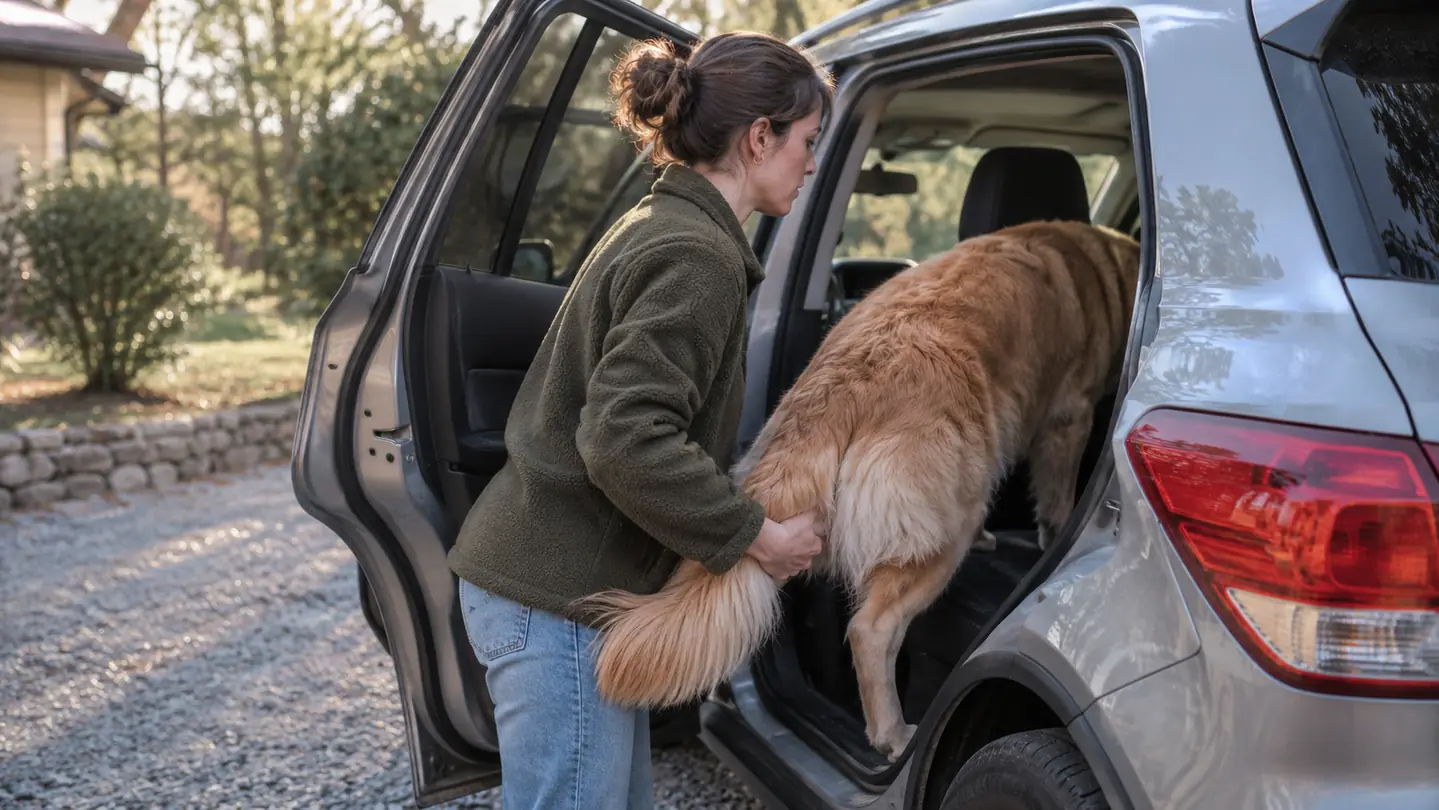
The car is the second place it earns its hook. Our CR-V has a back seat Gus steps up into, and first thing in the morning that step is more than his hips want. I stand at the open door with the sling under his rear end and let him step up on his own while I take a share of the weight. Coming out is the same maneuver in reverse, and slower.
The first dozen times, do this on carpet with nothing at stake. Not on the porch, not at the car, not on a morning when you are already late. That is the part I wish someone had told me in February instead of my learning it in the rain.
Step 3: Take some of the weight, not all of it
This is the whole skill and it is the part people get wrong. You are not carrying the dog. You are taking a share of what his back end is doing so his own legs can keep doing the rest. If his back feet are off the ground or dangling, you have lifted him clear and the walk is over.
Walk beside his hip, not ahead of him. Let your arm follow his stride instead of setting the pace. On the porch steps I go down first and keep the sling at a height where his rear end stays roughly level with his shoulders, which means my hand drops a little with each step rather than staying fixed in one spot.
My husband Mike is sixty-three and coached baseball for a living, and his instinct is to lift. We had a short, direct conversation about it on the second wet morning. He was not hurting Gus. He was doing so much of the work that Gus stopped doing any, and a dog who is carried down three steps is not practicing three steps.
Leash in one hand, handle in the other, and let the leash stay loose. A tight leash pulls a dog forward and sideways while you are trying to hold him level, and the two of you end up arguing on the top step. Gus wears a plain collar and we keep the leash short enough to keep him from bolting, no shorter.
Step 4: Practice on a good day, before the bad one
The morning the sling came out of the bag was a wet one in February 2026. Gus came through the back door, put a back foot on the first step, and both back legs slid out from under him. He sat down hard and looked back at me. He was not hurt. Nobody in this house had ever put a sling on a dog, and the first attempt involved a good deal of fumbling.
So we practiced in the den, on the carpet, on days when he did not need it. Three or four minutes, a few steps, a treat, done. It took about a week before my hands knew what to do without my thinking about it, and about the same before Gus stopped bracing when I reached for him.
That bracing is worth watching for. A dog who has slipped learns to expect it, and a dog who expects it will fight the thing that is trying to help him. Short sessions, a treat after, and no lifting on the practice days go a long way toward undoing it.
Now it goes on in a few seconds. That matters more than it sounds like it should. A tool that takes half a minute to sort out gets left on the hook on the exact morning you need it.
Step 5: Keep it where the trouble is, and wash it
Ours lives in its storage bag on a hook by the back door, which is the door the porch steps are on. Not in a closet, not in the car, not in a drawer. If it is not within reach when you are holding a leash and a wet dog is deciding whether to trust the steps, it may as well not exist.
It comes out two or three times a week, not every day. Rainy mornings, mornings when he is stiff, and getting in and out of the CR-V. The rest of the week it stays on the hook. This is a tool for a specific twenty seconds, and treating it as a daily routine would be solving a problem Gus does not have.
The PICK FOR LIFE sling is nylon and machine washable, which matters, because a sling that goes onto wet steps and under a dog's rear end is going to get dirty. Ours goes in with the towels about once a month and hangs to dry. The whole thing weighs 8.8 ounces and folds into the bag, so it is easy to keep with you. There is a short user guide in the package. I read it. You should too.
What Else Helps
A sling is one piece of a week, and it is not the piece that changed the most. What changed the most was the bed. We bought an orthopedic bed in March 2025 to replace a flat pillow-style bed we had kept for six years, and he was getting up easier within about two weeks. A foam ramp beside the loveseat, bought that June, ended the jumping question. Keeping his weight where Dr. Renner wanted it is the one thing she asked for that we still work at, every week.
The sling is also not the only shape this comes in, and it is worth knowing that before you buy. I looked at a full-body support harness at Dr. Renner's office once, the kind that goes around both the chest and the hindquarters, and for a dog who needs help at both ends that may be the right answer. For a dog whose front end is fine, a sling on the rear is less to put on and less to take off, which is why ours is on a hook and not in a box.
One dog is not proof of anything. I can tell you what we did and what we saw, and I can tell you that a wet morning in February went differently than the wet mornings before it. I cannot tell you your dog will be the same, and I would not trust anyone who could. What I would ask of you is to keep a note on the calendar, good days and bad days, because Dr. Renner asks questions I cannot answer from memory, and a month of marks on a calendar is worth more than anything I could tell her from the floor of the exam room.
The sling does not make his hips better. It buys him the twenty seconds it takes to get down three wet steps with his back end still under him, and on some mornings that is the whole difference.
The hook by the back door, and the mornings it earns
Ours is a PICK FOR LIFE sling: nylon, one padded handle, a storage bag, machine washable. It is not a cure and it is not a daily routine. It is the thing that comes off the hook on wet mornings, and after watching Gus take his porch steps like a dog instead of a question, I would buy it again.
Amazon Check Today's Price on Amazon →