
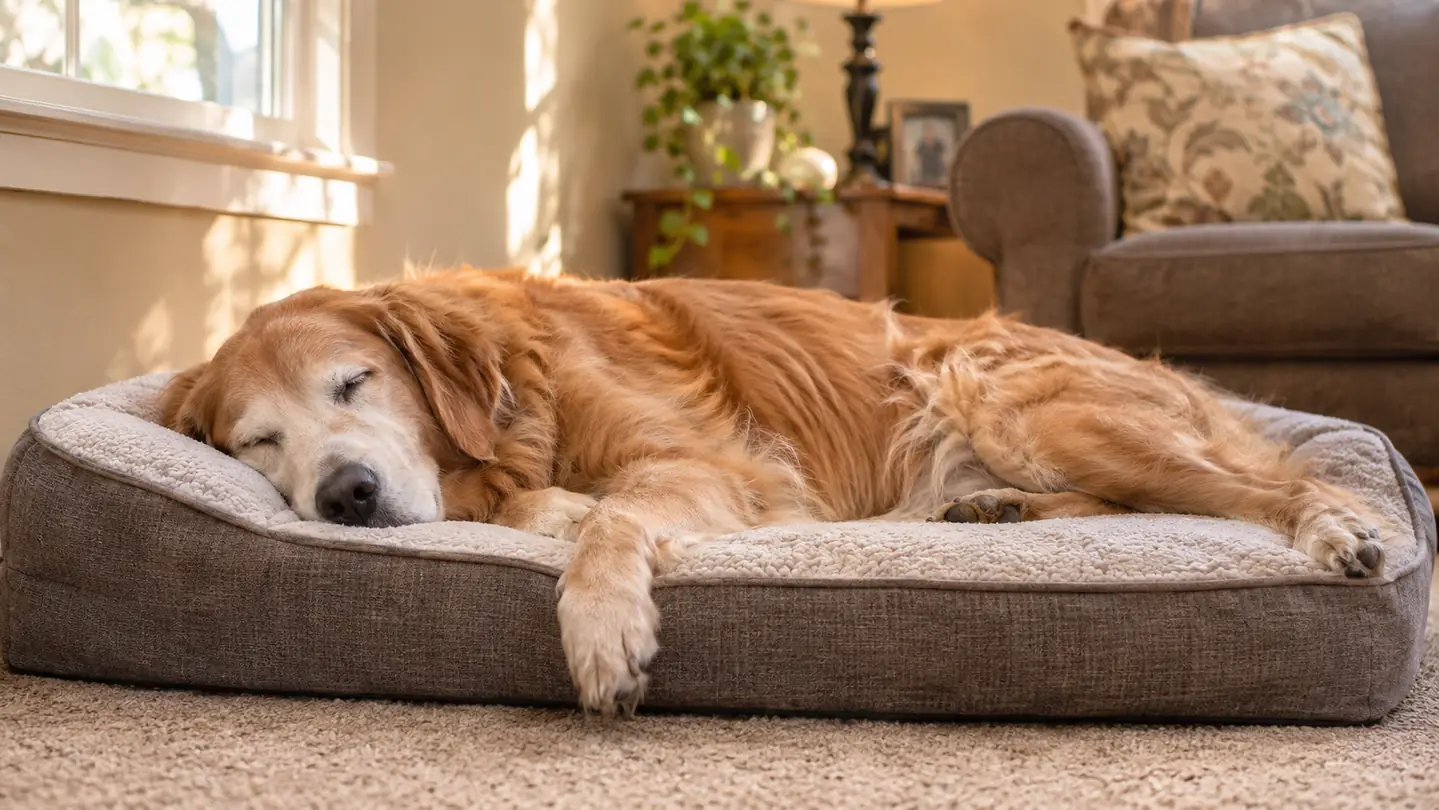
The first thing I noticed about Gus was not a limp. It was a pause. In October 2024 he would finish his morning walk and then stand at the back door a beat longer than he ever had, push up in stages, front end first, and take the three wooden porch steps one at a time.
I taped ankles for thirty-one years at one East Texas high school, and thirty-one years of that teaches you to watch transitions, not the walk. Standing up. Lying down. Getting out of the car. I had been watching all of them. What I had not watched was where he spent nine hours a night. Gus is twelve, a Brittany mix, forty-six pounds, with arthritis in both hips, worse on the left, seen on X-rays at his visit with Dr. Renner in November 2024. His bed was a flat pillow-style thing we had owned for six years, and when I put my hand on it in February 2025, it was about an inch thick in the middle and stayed flattened after I lifted my hand. We replaced it that March with the Bedsure orthopedic dog bed that now sits in the corner of the den.
The nine hours a night he spends on the floor are the ones you can fix this week
You cannot change the arthritis. You can change what his hips are lying on for a third of every day. That is the piece within reach.
Amazon Check Today's Price on Amazon →Step 1: Watch the transitions, not the dog
Spend three evenings watching how your dog gets up before you spend a dime on anything. You are not looking for a limp. You are looking for a hitch. A dog with sore hips will often push up with the front legs first and then rock the back end under himself. He may circle three or four times before he lies down, not because he is fussy but because he is trying to find an angle that does not hurt. He may stop halfway down and just stand there for a second.
Watch four moments: rising from a lie-down, lying down, going up or down a step, and getting into the car. Write down which moment is worst and what time of day it happens. For Gus it was the first rise of the morning, every single time, and the loveseat in the evening. That told me the problem was not the walk. It was the surfaces he was asking his hips to work on.
I kept that list on the back of an envelope for two weeks, and the dates are still on it. October 14, worse than the day before. October 19, skipped the loveseat entirely and lay flat on the carpet instead. October 26, took the porch steps one foot per step rather than two. That envelope is the only reason I can tell you now what changed and what did not. Without it I would have sworn by the end of March that the bed had fixed everything. Memory is generous with us. Write it down, or you will be guessing at your own dog.
I have watched a lot of kids favor an ankle, and the pattern is always the same: they change the way they move to avoid the sore part, and then something else starts hurting. Dogs do that too. If your dog is pushing up with the front end every morning, the front end is doing work it was not built to do. That is worth mentioning to your vet at the next visit.
Step 2: Measure him flat and measure the floor
The bed we had was flat, and flat is the wrong shape for sore hips. What you want is a surface that gives under the bony parts and still holds the body roughly level, so he is not lying in a shallow bowl with his rear end lower than his shoulders.
Two measurements before you buy. First, measure him lying flat, nose to the base of the tail, and add a few inches so he can stretch out. Second, measure the floor space where the bed will actually go, including the room he needs to step on and off it. The Bedsure bed we bought is 38 inches long, 28 inches wide, and 6.5 inches thick. Gus is forty-six pounds. Lying flat he uses most of that 38 inches, and he sleeps stretched out rather than curled, so the length mattered more than I expected it to.
Before we bought anything I tried the cheap version, which is what I would try again if I had to start over. I folded a doubled quilt into the old flat bed and put it under him one night in February. By morning it had compressed to nothing under his hips, because a quilt has no structure of its own, it only takes the shape of whatever is pressing on it. I tried two quilts the next night. Same result, and worse, the whole stack slid sideways when he stepped on it. A blanket over a flat bed is not a cushion. It is a blanket, and he was still doing the hardest work of his day on an inch of nothing.
Then look at what is inside. Ours is egg-foam with a removable cover and a waterproof layer beneath it, and the four raised sides are what Gus rests his chin on. I did not think the sides would matter. They do. He settles faster when his head is up on something.
Step 3: Put it where he already sleeps
Put the bed in the corner he already chooses, not the corner that looks best from the doorway. Ours is in the den, on carpet, against the wall, a few feet from the loveseat. Carpet matters more than people realize. A dog with sore hips pushing up off tile has nothing to grip, and the back feet slide out from under him. On carpet they stay put.
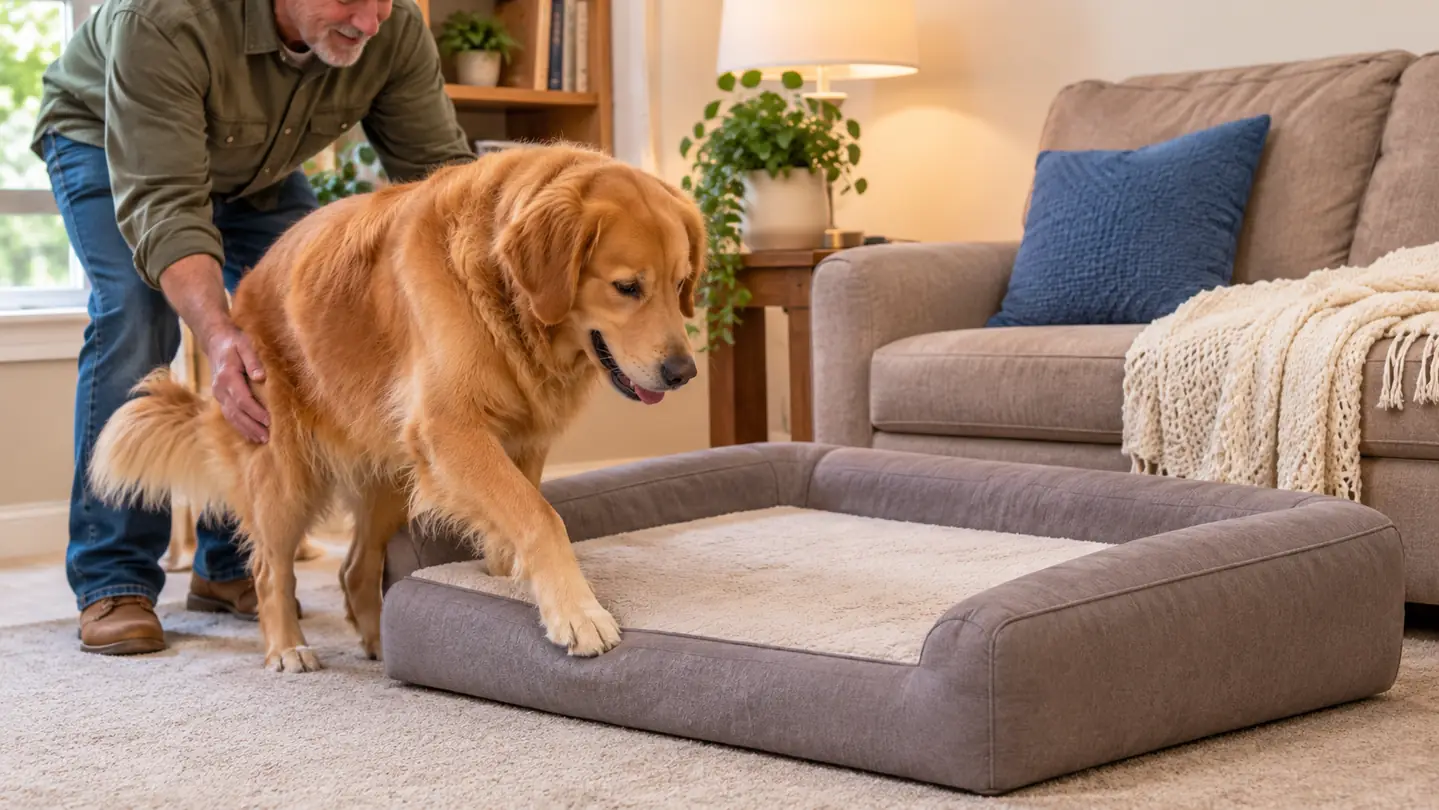
If the bed has a low front and raised sides, turn the low side toward the middle of the room so he can walk on rather than climb on. Ours went in with the opening facing the room. The first night he circled it twice and stepped in. The second night he went straight to it.
I also moved the water bowl. Gus had been walking from the bed to the far side of the kitchen for a drink at night, which is a long way across tile for a dog who is stiff, so the bowl came to the near side of the kitchen. Small thing. He drinks more now, and he is not doing a lap of the house at two in the morning to get a drink. If your dog is on any medication, ask your vet how much water he should be taking in, because that is one of those things that is easy to stop noticing until it is a problem.
Do not move it once he has picked it. Dogs build a map of the house, and a sore dog is more careful with his map than a sound one. The only change we made in twenty months was a wash day, and he stood and stared at the empty corner until the cover went back on.
Step 4: Let him get up on his own
The most useful change was not the bed itself. It was that I stopped helping him up in the morning. A dog hurried to his feet before he has sorted out his back legs will stiffen and stumble. So I let him do it. He gets the front end up, pauses, rocks the back end under himself, and stands. It takes maybe four seconds longer than it used to. I stand there with my coffee and let him finish.
Keep the room warm overnight if you can, and keep the path from the bed to the back door clear so he is not stepping around anything in the dark. Cold mornings are the bad ones. Wet porch steps are the reason we eventually bought a sling, which is a separate job and I will get to it.
We also put a cheap runner rug down on the tile between the den and the back door, because that stretch is where he was losing traction on the way out in the morning. It is nothing to look at, a plain brown thing Mike picked up in Tyler. It has been down since April 2025 and I would put it down again tomorrow. A dog that slips once gets careful, and a careful dog moves less, and a dog that moves less gets stiffer. Breaking that loop is worth as much as any single purchase on this list.
Within about two weeks of switching beds, the morning rise was easier. Not fixed. Easier. He still takes the porch steps one at a time and still stops at the bottom to think about it. But he quit standing at the back door doing that slow rock, and that was the change I was watching for.
Step 5: Keep the bed worth sleeping on
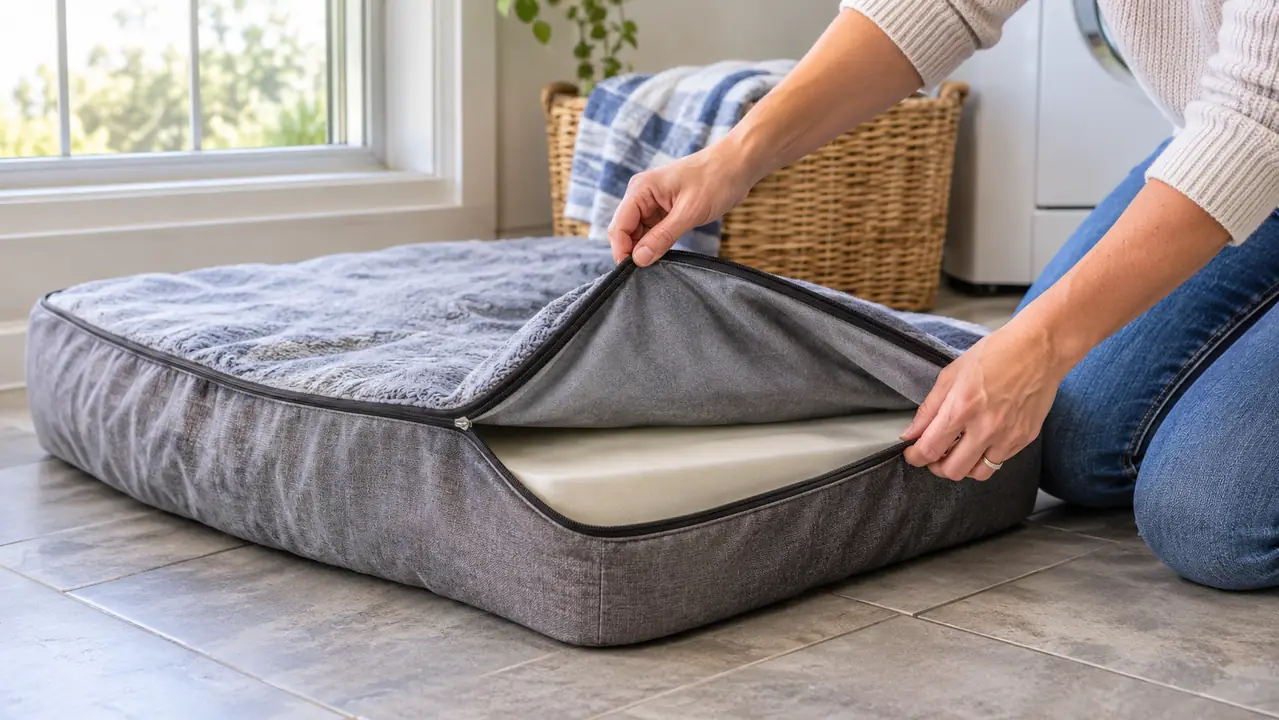
A bed for a sore dog is only as good as its shape, and foam flattens. Once a month, pull the cover off and put your flat hand on the foam in the spot where he sleeps. If your hand sinks down without much resistance, the support is gone and no amount of washing will bring it back.
The cover on the Bedsure comes off and goes in the wash, and we do it about once a month. Under it is a waterproof layer, which has saved the foam more than once, because a twelve-year-old dog does not always wake up for everything. Wash the cover cold, air dry it if you can, and put it back the same afternoon so he is not displaced for a night.
I also stopped letting him sleep on the bare carpet beside the bed, which he tried for a week in the beginning because the bed was new and he is a creature of habit. I did not make a project of it. I called him over at bedtime and he came. Two weeks in he was going to it on his own, and by the end of March he had quit the carpet entirely, except on the nights the cover was in the wash and the corner smelled wrong to him.
Twenty months in, the foam in ours is still holding its shape. I check it the same way each time: flat hand, middle of the bed, right where he lies. When that changes, I will replace the bed that same week. A flattened orthopedic bed is just a flat bed with a nicer label on it.
What Else Helps
Everything below is what we did, in the order we did it. None of it is a cure, and I am not a veterinarian. Take it to your vet and get their read on it. One dog is not proof of anything except what happened to one dog.
Weight first. Dr. Renner asked us to keep Gus lean, and that has done as much for him as anything we bought. Forty-six pounds is where he needs to stay, and we weigh him on the same scale at the same visit each time so we are comparing like to like. A few extra pounds on a dog with sore hips is a tax he pays every time he stands.
The joint chew is a breakfast item and stays in the cabinet above the coffee maker. The salmon oil goes over his dinner and the bottle lives in the refrigerator door. Both are daily habits, not rescue measures, and I cannot tell you which one did what. The foam ramp sits beside the loveseat in the den, and only the loveseat, because Gus misjudged a jump onto it one evening and slid back down. At forty-six pounds he is near the top of what that ramp is rated for and I say so plainly. The sling hangs by the back door and comes out for wet porch steps and for getting in and out of the Honda, two or three times a week, not every day.
He was doing the hardest work of his day, the getting up, on an inch of flattened pillow.
Start with the surface, because it is the one thing you can change tonight
His hips are going to hurt either way. Where he spends the night is a decision you still get to make.
Amazon See the Bedsure Orthopedic Dog Bed on Amazon →