
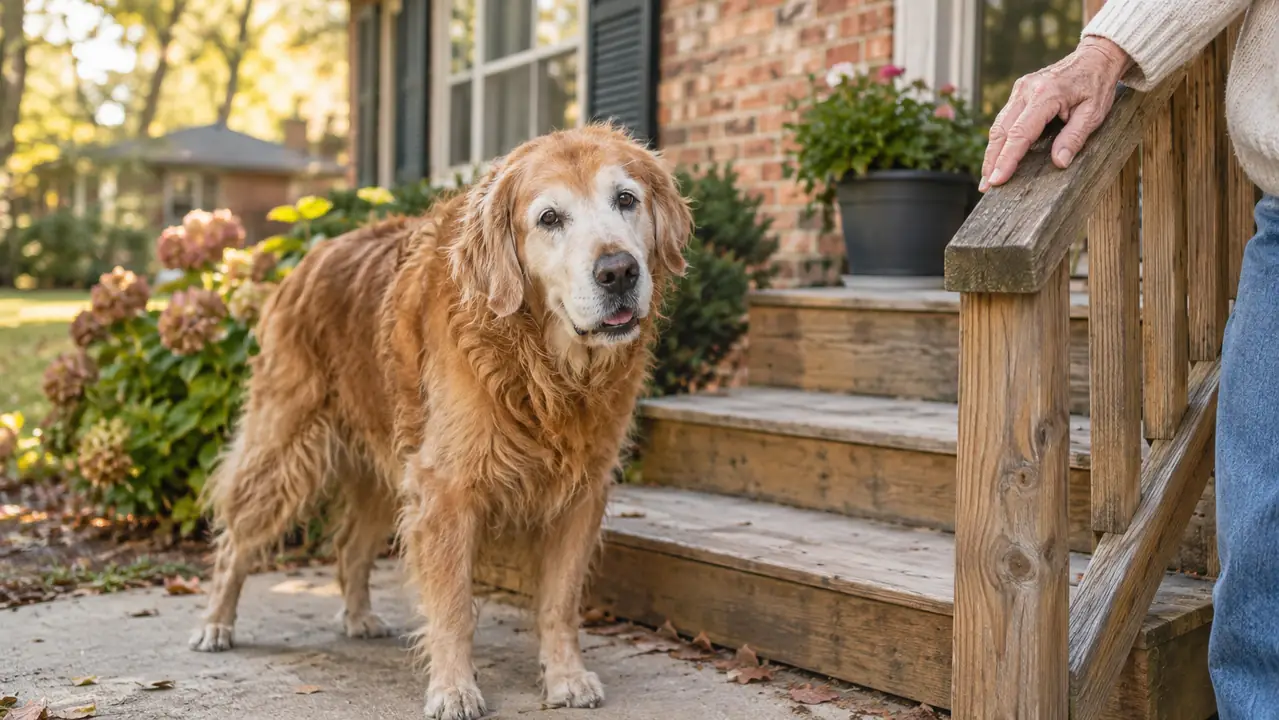
The first time I saw Gus stop at the bottom of our three back porch steps, I did what I used to do on the sideline: I watched his feet. He is a 12-year-old Brittany mix, 46 pounds, and he had been slowing down for a couple of weeks. In November 2024, Dr. Renner took X-rays and found arthritis in both hips, worse on the left. She suggested the Cosequin soft chews from Nutramax Laboratories, asked us to keep his weight down, and told us to give it time.
I am not a veterinarian. I spent 31 years taping ankles and watching kids walk back onto a field, so I know a little about gait and a lot about impatience. What follows is not a protocol for every dog. It is what Mike and I did with our one dog, what we saw, and the questions I would put to your vet before you change anything.
The Soft Chew Dr. Renner Put on Our Kitchen Counter
Cosequin is a soft chew for joint health, and it was the first thing we changed in November 2024. We give Gus the amount on the label for his weight at breakfast. If your dog is stiff on the steps, this is a conversation to have with your vet, not a decision to make from a web page.
Amazon Check Today's Price on Amazon →The Routine That Got Gus Up the Steps
Before I get to the steps, understand what we were working with. Our house is one story. There are no indoor stairs. The only steps Gus has to manage are the three wooden ones off the back porch, and on a wet morning they might as well be a ladder. The routine below is the order we did things, not a schedule I would hand to every family.
Step 1: Have Your Vet Look at the Dog, Not Just the Stairs
I have watched a lot of people decide a limp is just age. Sometimes it is. Sometimes it is a torn ligament, a sore back, or something that needs more than a chew. Dr. Renner examined Gus, took X-rays in November 2024, and gave us the arthritis diagnosis in both hips, worse on the left. That visit is why I can write this without guessing.
If your dog has started hesitating at the stairs, ask your vet what is actually going on before you buy anything. Ask whether pain control should be part of the plan. Ask what weight your dog should be at. Ask whether exercise should change. I am not a veterinarian, and I am not going to pretend a supplement is a diagnosis.
The other thing I asked about was the steps themselves. Dr. Renner did not tell us to carry Gus up and down. She asked us to watch him and keep him moving. That mattered to me. A dog who stops using the stairs altogether gets weaker, and a dog who keeps slipping on wet wood gets scared of them. We needed a middle path.
Step 2: Start the Cosequin Soft Chews at Breakfast and Keep It Boring
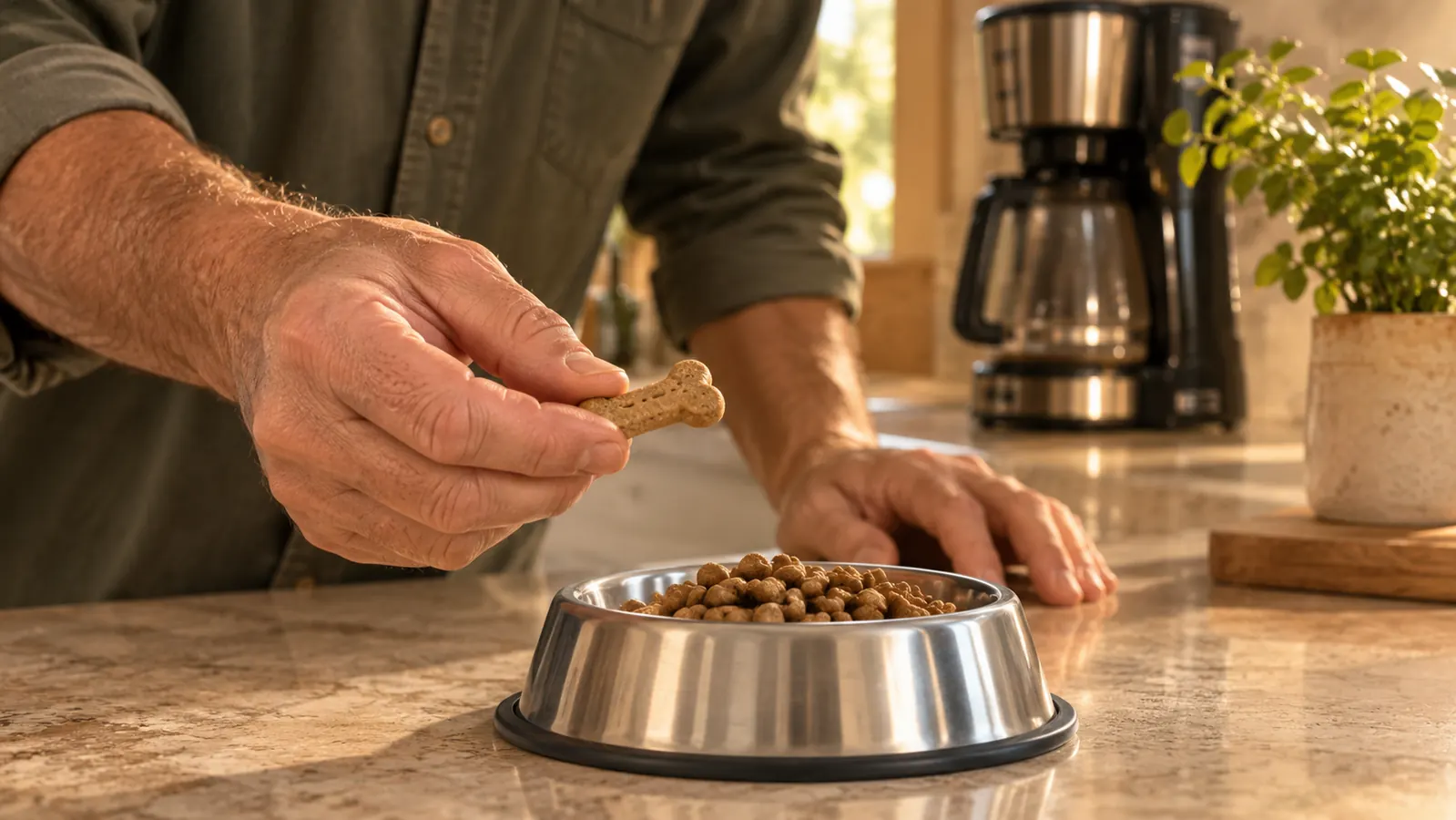
We started the Cosequin soft chews in November 2024, at Dr. Renner's suggestion. The instructions on the label give an amount for the dog's weight, and that is what we give Gus at breakfast. The 60-count container stays in the kitchen cabinet above the coffee maker so I do not have to remember a second location at 6:30 in the morning. Cosequin is made by Nutramax Laboratories, and the formula lists glucosamine hydrochloride, MSM, and sodium chondroitin sulfate. I am not going to turn those words into a promise. I can tell you what we saw.
Before the vet visit, in October 2024, we tried one package of a generic farm store glucosamine chew for about a month. Gus picked around it, and we saw nothing either way. That is not a knock on every generic chew. It is just what happened here. When we switched to the Cosequin chews, he ate them without a fight, which matters when you are trying to keep a routine for two years.
The first change was small. Around 6 to 8 weeks in, January 2025, I noticed that Gus got up after his morning walk without the long pause he had been taking. He was not trotting. He was not a puppy. He was just easier to get moving. One dog and one observation is not proof, and I will keep saying that. But it was enough for us to keep the container in the cabinet. Two years later, the container from Nutramax Laboratories is still there.
Step 3: Make the Three Steps Less Slippery and Less Scary
Those back steps are wood, and East Texas humidity does not do wood any favors. I sweep them every morning and Mike checks them for soft boards. We keep the porch light working. That sounds too simple to matter, but a stiff dog reads a dark step differently than a young one does. He needs to see where his back feet are going.
We also tried a neighbor's hard plastic pet stairs for a weekend in May 2025. Gus's feet slipped on them, and he did not want to use them again. We gave them back. If you are considering a set of stairs or a ramp for your porch, watch your dog's feet on the surface before you decide. A product can be sturdy and still be wrong for a dog with bad hips.
I want to be clear about one thing: the foam ramp we bought in June 2025 is not for the porch. It stays beside the loveseat in the den, because that is the job we bought it for. The porch is still three wooden steps, and our job is to keep them dry, lit, and familiar. A dog with arthritis does better with a path he knows than with a new obstacle every week.
Step 4: Use a Sling on Bad Mornings, Not Every Morning
In February 2026, on a rainy morning, Gus's back legs slid out from under him on the wet porch steps. He was not hurt. That was the morning I ordered a PICK FOR LIFE sling. It hangs in its storage bag on a hook by the back door, and it comes out on rainy days, bad mornings, and when he needs help getting in and out of the CR-V.
Mike or I lift lightly at the back end while Gus walks. The point is not to carry him. The point is to take some weight off the back legs for a few steps so he can keep moving on his own. We use it two or three times a week, not every day. On a good morning it stays on the hook.
If your dog is falling on stairs, a sling is one of those tools that can make the difference between a scary morning and a manageable one. But it is not a substitute for a vet visit, and it is not a full-body harness. We have never owned one of those. I only looked at one at Dr. Renner's office. The sling does one job for us: a little lift at the back end when Gus needs it.
Step 5: Change One Thing at a Time and Write Down What You See
We did not start everything at once. The Cosequin chews came in November 2024. The salmon oil came in January 2025. The orthopedic bed came in March 2025. The foam ramp came in June 2025. The sling came in February 2026. That order was not a grand plan. It was us trying to keep track of what happened after each change.
If you start a chew, a new food, a bed, and a ramp in the same week, you will not know what helped. Pick one thing, give it 6 to 8 weeks if your vet agrees, and write down what you see. I watched two things: how Gus got up after his walk, and how he took the three porch steps. I did not watch for a sudden change. I watched for less hesitation.
I also cannot separate what the salmon oil did for his joints from what the chew did. His coat got softer around 6 weeks after we started the oil, and I can say that plainly. But joint changes are slower and muddier. That is why the notes matter. Your vet can look at a log and see a pattern. You cannot see a pattern from memory.
What Else Helps
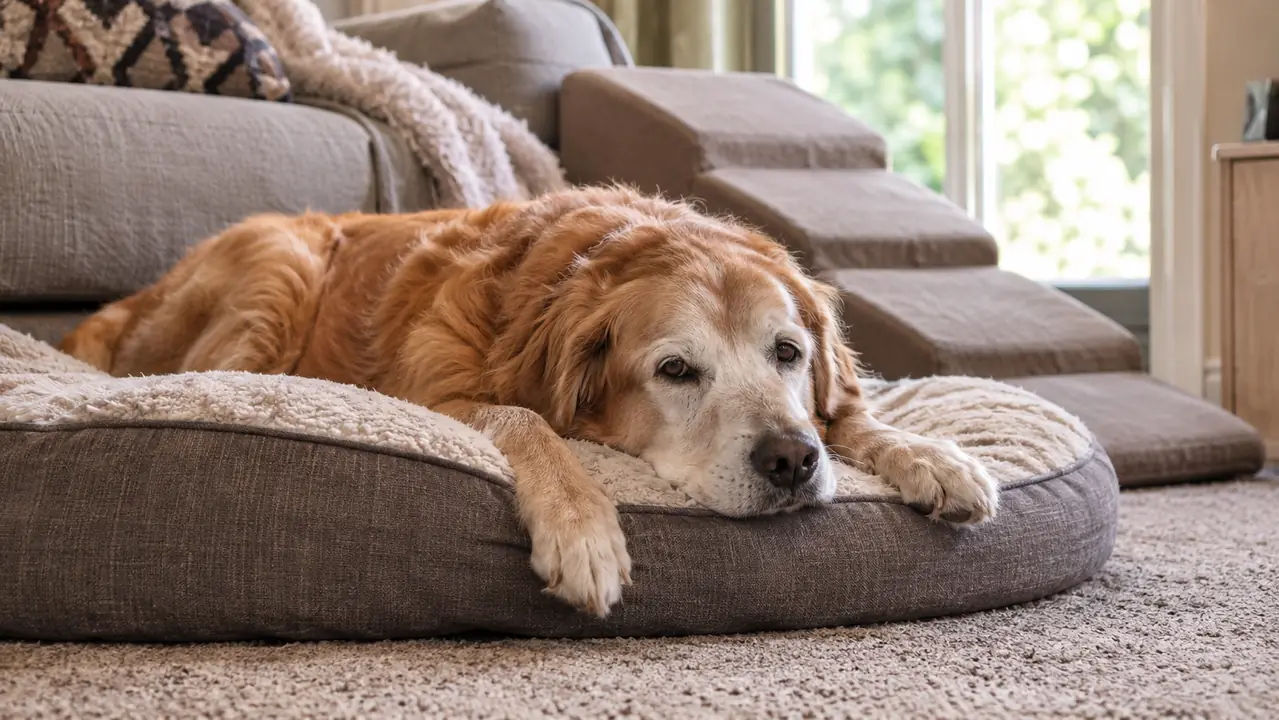
Three other things have mattered as much as any chew. The first is weight. Dr. Renner asked us to keep Gus's weight down, and we have. A 46-pound dog with arthritis in both hips does not need extra pounds on those joints. The second is sleep. We bought a Bedsure orthopedic bed in March 2025 to replace a flat pillow-style bed we had for six years. It sits in the corner of the den, and within about two weeks it was easier for Gus to get up in the morning. The cover comes off and gets washed about once a month. The foam is still holding its shape after 20 months.
The third is the salmon oil. We started Natural Dog Company salmon oil in January 2025, pumped over dinner, the amount on the label for his weight. The bottle lives in the refrigerator door. His coat got softer around 6 weeks in. It smells strong and the pump can drip, so I keep a paper towel under it. I cannot tell you what it did for his joints. I can tell you we kept using it.
We also bought a Topmart foam ramp in June 2025, the week after Gus misjudged a jump onto the loveseat and slid back down. The ramp stays beside the loveseat. It is rated to 50 pounds with best comfort under 35, so at 46 pounds Gus is near the top of that range. I would rather say that out loud than pretend it is a perfect fit. It took about a week of treats before he used it by himself. It is not for the porch and not for the car.
What I Would Ask Your Vet
Before you start a joint chew, ask what your vet wants to rule out. Ask whether your dog needs pain medication now or later. Gus and I have had that conversation with Dr. Renner more than once, and the answer so far is that he is not on prescription pain medication. That may change. It is not a failure if it does.
Ask how much exercise your dog should get on a bad day. Ask what weight is right. Ask whether a sling, a ramp, or a set of stairs makes sense for your house, and be honest about your own knees and your own schedule. The best setup is the one you will actually use.
The change I could point to was small and specific: by January 2025, about 6 to 8 weeks after we started the Cosequin chews, Gus got up after his morning walk without that long pause.
If Your Dog Is Stopping at the Steps, Start With Your Vet and a Boring Routine
We are two years into the Cosequin soft chews with Gus. The stairs are still three steps, he is still stiff some mornings, and he still goes for his walk. That is the honest version. Ask your vet what is right for your dog, then decide.
Amazon Check Today's Price on Amazon →