
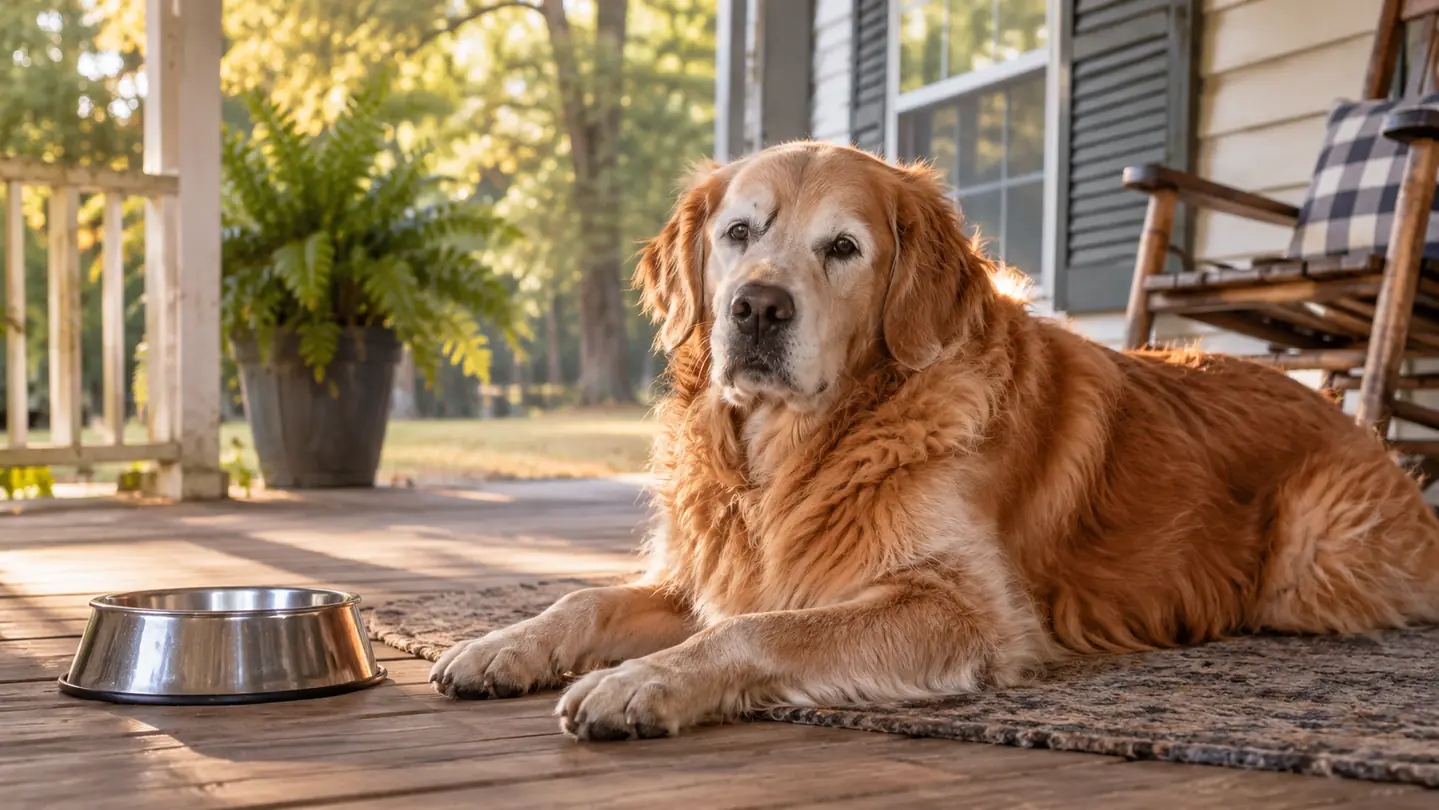
The first time I noticed Gus hesitating at the three wooden back porch steps, I had a coffee cup in my hand and no plan at all. He is a 12 year old Brittany mix, 46 pounds, brown and white, and he has walked those steps every day of his life. He did not stop. He took them one at a time, then stood at the bottom a second longer than he used to. I spent 31 years taping ankles and watching teenagers come back from injuries, and I know a body that is protecting itself when I see one. That was October 2024.
By November, Dr. Renner had X-rays showing arthritis in both hips, worse on the left. She suggested a joint chew and asked us to keep his weight down. The oil came later, in January 2025, and the one that stayed in our refrigerator door is Natural Dog Company Wild Alaskan Salmon Oil, the 16 ounce bottle with a pump. Before that we spent two weeks trying Mike's human fish oil capsules, and Gus spat them out on the kitchen tile. I am not a veterinarian. I am a retired athletic trainer who has had a dog underfoot most of her life. What follows is how we added the oil to his bowl, what I watched for, and what I would ask Dr. Renner if I were starting over.
The salmon oil that stayed in our refrigerator door
It is a 16 ounce bottle with a pump, and the label gives the amount for a dog's weight. Start there, then ask your vet if it fits your dog's situation.
Amazon Check Today's Price on Amazon →Step 1: Get a baseline before you change the bowl
Before I added anything to Gus's dinner, I wrote down what a normal day looked like. I am not organized by nature, but I can keep a note on the refrigerator. I wrote down how long it took him to rise after his morning walk, whether he used the loveseat in the den, and how he came down the porch steps. I did not write "seems stiff" because that tells me nothing. I wrote "took about four seconds to get his back legs under him" or "walked past the loveseat and lay on the carpet." A baseline is not a medical test. It is a plain record of what you already see.
I also took him to Dr. Renner before I bought the oil. That is not a formality. Gus had X-rays in November 2024, and I wanted her to know what I was adding and why. She is the one who told us to keep his weight down, and she is the one I would call if his appetite changed or his walking changed in a way that worried me. If your dog has not been seen for the slowing down you are noticing, start there. A bottle of oil is not a substitute for a diagnosis.
The other part of the baseline is the food. If your dog is a picky eater, or has a sensitive stomach, or is already on a prescription diet, that is a conversation for your vet. I did not change Gus's kibble at the same time I started the oil. One change at a time is the only way I know to tell what did what. That is not a rule from a study. It is common sense from a house with one dog and two retired people who do not need a mystery on their hands.
Step 2: Read the label for your dog's weight, not mine
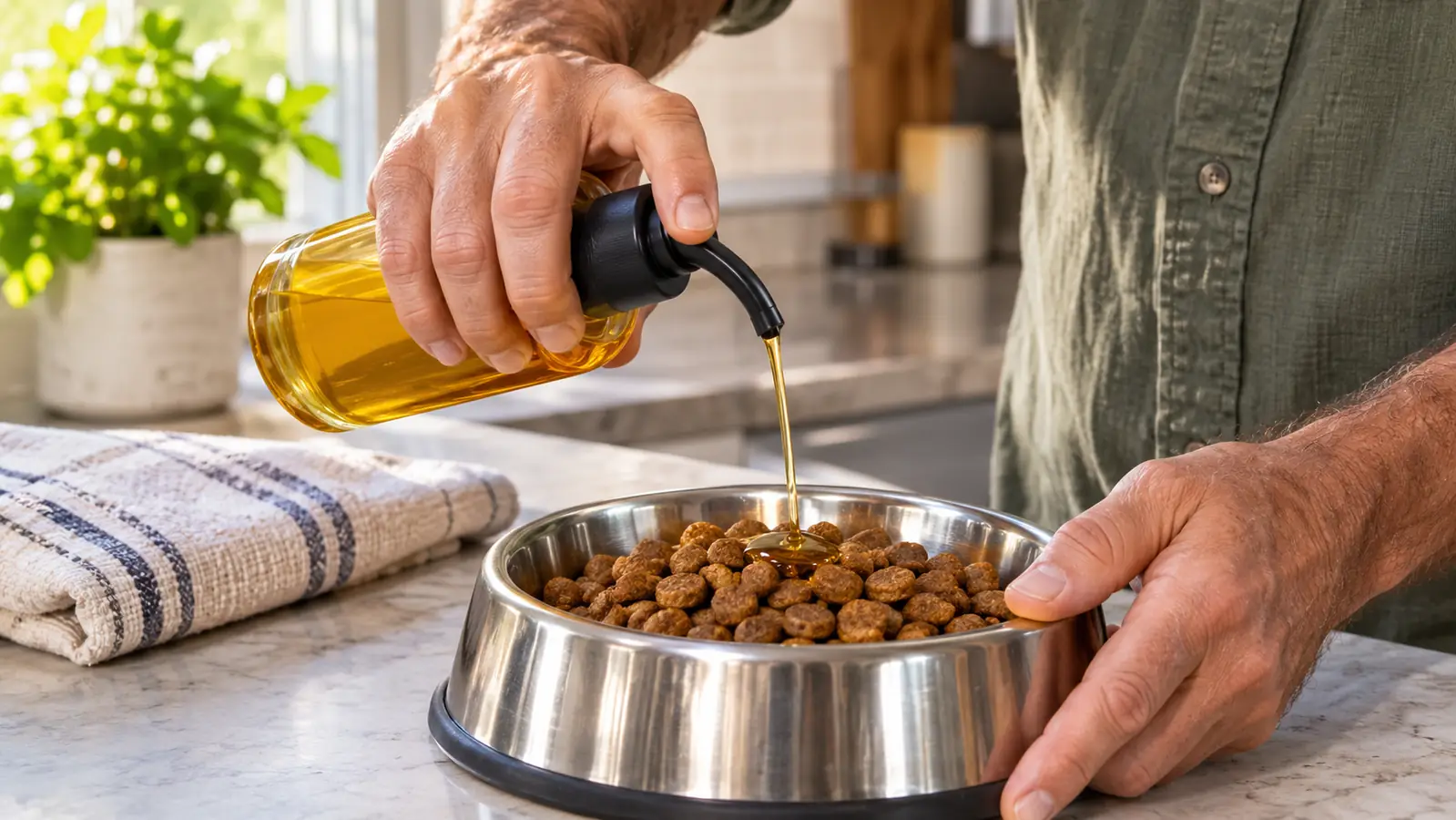
The bottle gives an amount based on weight. Gus was 46 pounds when we started, and the amount on the label for his weight is what we use. I am not going to give you a pump count, because pumps can vary and because your dog is not my dog. If the label says to ask a veterinarian, ask. If your dog is on another medication, ask. If your dog is a puppy, a senior with kidney issues, or a dog with a history of pancreatitis, ask. I mean that plainly. I have seen too many people on a sideline guess at a dose and then wonder why the guess did not work.
We keep the Natural Dog Company bottle in the refrigerator door. That is where it lives, next to the butter and a jar of pickles. The pump can drip a little when you pull it back, so I hold the bottle over the bowl and not over the floor. It smells strong. Salmon oil is going to smell like fish, and if that bothers you, it will bother you every night. Gus does not mind it. He licks the bowl clean, which is the only review that matters to him.
One more thing about the label. It lists EPA and DHA omega-3 fatty acids, and omega-6. It is a liquid food topper. It is not a pain pill, and it is not going to work like one. If your dog is in obvious pain, call your vet. Do not wait six weeks on a bottle because a stranger on the internet said it helped her dog. That stranger is me, and I am telling you to call your vet.
Step 3: Put it on a meal your dog already finishes
We add it at dinner, not breakfast. Breakfast is the joint chew, and dinner is the oil. That is not because one time of day is better than another. It is because Gus is a creature of habit, and so am I. He knows the sound of the bowl on the tile. He knows the pump. If I started putting oil in a meal he sometimes leaves half of, I would never know how much he actually got.
The method is simple. I put his kibble in the bowl, pump the amount for his weight over the top, and stir it once with a fork. If I am adding anything else, like a little warm water, I do that after. The Natural Dog Company bottle has a pump that can drip, so I keep it low over the bowl. The oil sits on top of dry kibble fine, but it will coat the bowl and the kibble, and some dogs will eat around a puddle if it is all in one spot. Stirring takes five seconds and saves me from watching him push food to the side.
If your dog is a fast eater, watch the first few meals. Not because the oil is dangerous, but because a new food topper can go down faster than a stomach likes. If your dog is a slow or picky eater, start with less than the label suggests and build up, or ask your vet how to introduce it. I am not a veterinarian and I am not going to pretend one method fits every dog. I can tell you what worked at our house, and what worked was boring and the same every night.
Step 4: Watch the bowl, the coat, and the walk
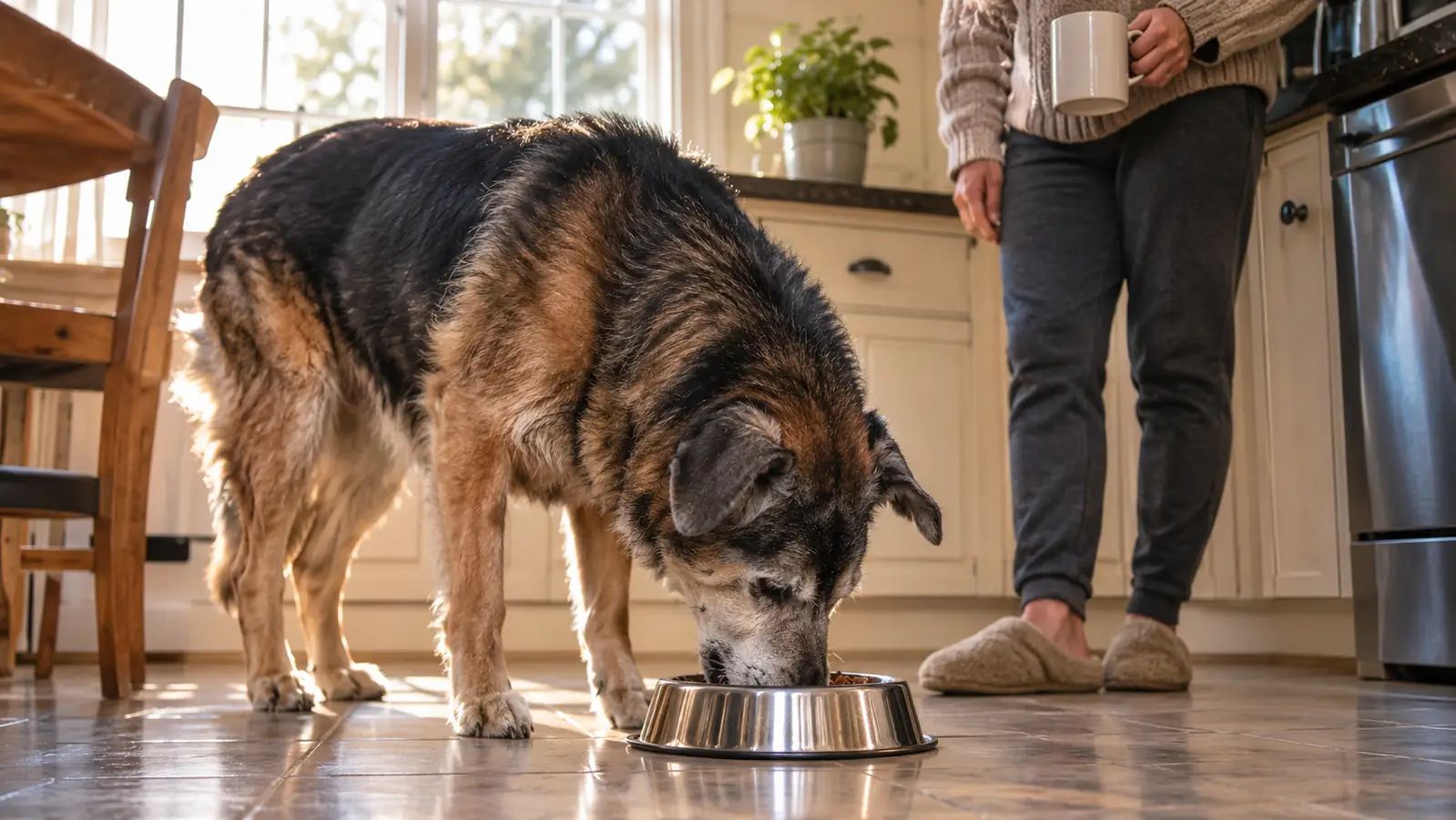
I did not expect to see anything in a week. I have watched enough bodies come back from injuries to know that the small stuff is slow. We started in January 2025. Around six weeks in, I noticed his coat felt softer when I ran my hand down his side. That is not a joint result. It is a coat result, and I will take it. I also noticed he was finishing his dinner with the same enthusiasm, which mattered to me, because a supplement only works if it goes in the dog.
What I cannot tell you is that the oil made his hips better. He is also on the joint chew Dr. Renner suggested, and we started the oil about two months after the chew. I cannot separate one from the other. If I told you the oil was the reason he gets up easier, I would be guessing. What I can tell you is that he still walks every day, shorter than he used to, and he still uses the loveseat when he wants to. The oil is one part of that, and I do not know how big a part.
The things I watch for are not dramatic. I watch how he rises after a nap. I watch whether he stands at the bottom of the porch steps or takes them without a pause. I watch his appetite, because a dog that stops eating is a dog that needs a call to the vet. I watch his stool, because any change in food can change that. I do not keep a chart. I keep it in my head and on the refrigerator note, and I say it out loud to Dr. Renner at his visits.
Step 5: Give it weeks, not days, and change one thing at a time
The hardest part of this for me was the waiting. I am a person who wants to do something and see the result. A retired athletic trainer is not built for six weeks of nothing. But that is the timeline I would give anyone. Six to eight weeks is a fair window to decide whether a food topper is worth keeping in the routine. If you see no change in the bowl, the coat, or the walk by then, you have a decision to make. Talk to your vet before you add a second bottle or a third supplement.
We did not change everything at once. The chew came first. The oil came later. The bed came after that, and the ramp after that. When something changed for the better, I could not always say which thing did it, but at least I was not guessing across five changes in one week. That is the same advice I gave parents of injured kids. Do not add three new things and then credit the one you like best. One change, then wait.
One dog is not proof. Gus is one 12 year old Brittany mix with arthritis in both hips, and what I saw in him may not happen in your dog. I am not going to dress that up. I also would not keep a dog on something that did not seem to help. If the oil had made him sick, or if he had refused his food, I would have stopped. He did not. He is still on it, and the Natural Dog Company oil is still in the refrigerator door.
What Else Helps
The oil is not the only thing in our house that helps Gus get through a day. Dr. Renner asked us to keep his weight down, and that matters more than any bottle. A 46 pound dog who gains five pounds is carrying more load on hips that already hurt. We measure his food. We do not free feed. We walk every day, shorter than we used to, and we let him set the pace. If your dog is carrying extra weight, that is the first conversation to have with your vet, not the last.
The other helpers are practical. We bought an orthopedic bed for the den, and it made the morning get up easier within about two weeks. We bought a foam ramp for the loveseat after he misjudged a jump one evening and slid back down. It took about a week before he used it on his own. We keep a sling by the back door for wet porch steps and for getting in and out of the CR-V. None of those things takes the place of the vet. They just make the day less of a struggle. The salmon oil is one small part of a routine, not the whole routine.
If you are starting from zero, start with the vet and the weight. Then pick one food change. Then wait. That is the order I would use if I could go back to October 2024 and do it again.
Around six weeks in, his coat felt softer under my hand. I cannot tell you the oil fixed his hips, because he was already on the joint chew.
The 16 ounce bottle we still keep in the refrigerator door
If your dog is slowing down and your vet says a salmon oil topper is worth a try, this is the one we use. The label gives the amount for your dog's weight. Start there, and keep your vet in the loop.
Amazon Check Today's Price on Amazon →