

The first thing I noticed was not a limp. It was a pause. Gus would come up the three wooden steps off our back porch, put his front feet on the top one, and take one extra beat before he pushed his back end up after them. Thirty-one years of taping ankles at a high school taught me one useful thing: a body tells you early, but only if you are watching the right part of it. Everybody watches the foot. The interesting part is the weight shift.
That was October 2024. He was slower getting up after the morning walk, and some evenings he just stood beside the loveseat in the den and did not try. We took him to Dr. Renner, who has been his vet his whole life. X-rays in November 2024 showed arthritis in both hips, worse on the left. She suggested a joint chew, asked us to keep his weight down, and mentioned prescription pain medication as something to revisit later. That is how a container of Nutramax Laboratories Cosequin soft chews ended up in the cabinet above the coffee maker, where it has sat for two years. Here is what I can honestly tell you about it, including the parts that did nothing.
The Quick Verdict
A soft chew that showed me nothing for six weeks and then showed me something real. Four stars and not five, because patience is not printed anywhere on the label.
Amazon Check Today's Price →The One Supplement We Never Skipped in Two Years
It earned its spot above the coffee maker the slow way. Talk to your vet about the amount for your dog's weight, then take a look at today's price.
Amazon Check Today's Price on Amazon →How We Actually Used It
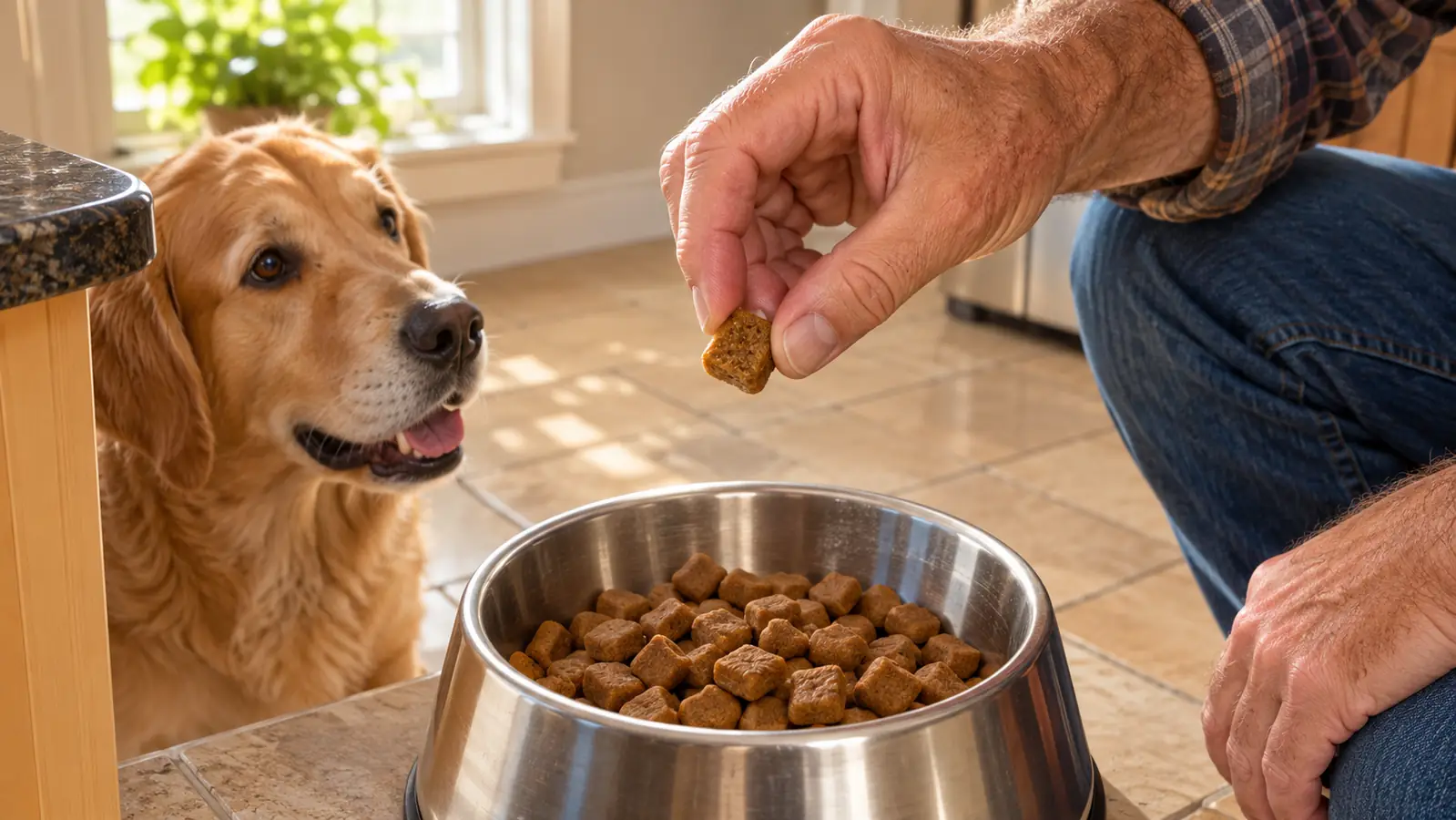
Dr. Renner did not hand us a promise. She handed us a plastic container and a short list of instructions: give it every day, use the amount the label gives for his weight, and keep his weight down. Nutramax makes Cosequin as a soft chew in a 60 count container with a natural flavor. Gus is 46 pounds, and I have never once had to coax him into it. It goes in the bowl with his kibble at breakfast, he eats it, and we move on with the morning. For a 12-year-old dog, the soft texture matters more than I expected. A hard chew would have turned breakfast into a negotiation, and I have met enough stubborn old dogs to know how those negotiations end.
I should tell you what we tried before this, because it is part of the honest answer. In October 2024, before the vet visit, we bought one bag of a generic glucosamine chew from the farm store out on the highway and gave it for about a month. I saw nothing either way. He also picked around it, ate the kibble and left the chew sitting in the bowl in pieces, and by the fourth week I was finding dried fragments at the bottom of the bowl every single morning. That is the entire story of that bag. One month is not a fair test of anything, and I know it.
The keeping place matters more than people admit. The container lives in the kitchen cabinet directly above the coffee maker, because that is where I am every morning at 6:20 whether I like it or not. I did not choose that spot for tidiness. I chose it because a daily supplement that lives in a closet is a supplement you will skip on the mornings you are running late, and there are more of those mornings than anyone plans for. It is also the reason the container has a dent in one corner now, from the one morning I set it on the counter edge and turned around too fast.
What Changed, and When
Here is the part I would want if I were reading this instead of writing it. For the first two weeks, nothing. At four weeks, still nothing. I had already started doing the math on how long I was willing to keep buying something on faith, and the number was getting small. Then somewhere around six to eight weeks in, which put us in January 2025, I caught myself standing at the bottom of the porch steps waiting for him and realizing I had not waited in a while. He was getting up on the first try again. Not fast. Just first.
I remember the specific morning because it was cold and wet, the kind of January day in East Texas where the porch steps stay slick until ten. Gus came out, put his front feet up, and pushed straight through without the pause. I stood there in my robe and my husband Mike asked from the doorway what I was looking at. It took me a second to answer, because what I was looking at was the absence of something, and that is a hard thing to point at.
What that looks like day to day is small and specific. He rises off the den carpet without that forward rocking motion. After his morning walk, which is shorter than it used to be, he comes in and lies down instead of standing in the kitchen looking uncertain for a minute. He still trots to the kitchen when the refrigerator opens, and he still sleeps a great deal, because he is twelve. None of this is dramatic. It is the kind of change you notice only because you were watching for it.
What it did not change is just as worth saying. The loveseat in the den is 14 inches at the seat, and he stopped hopping up onto it on his own some evenings back in October 2024. Cosequin did nothing about that. That situation needed a ramp, and eventually got one. If you are expecting a chew to solve the furniture problem, you are going to be disappointed, because the furniture problem is a jumping problem and no supplement is in the business of jumping.
Somewhere around six to eight weeks in, I realized I had stopped waiting at the bottom of the steps. He was getting up on the first try again. That is the whole of what I can honestly claim.
What Nobody Tells You About Joint Chews
The hardest part of this whole thing is the calendar, and nobody puts that on the front of the container. People quit at three weeks because nothing happened in three weeks. I nearly did. Six to eight weeks is not a slogan, it is the actual shape of our experience, and it means you are spending on faith through a stretch where you have no evidence at all. If you cannot commit to two months of daily use, you are better off saving the money and having a different conversation with your vet.
Second thing: daily means daily. It is easy to say and annoying to do. There were mornings we were out the door early for an appointment in Tyler and the container stayed in the cabinet. Nothing terrible happened on those days, but a supplement you take four days a week is not the same thing as the one Dr. Renner described, and I would rather be honest about our gaps than pretend we were perfect. The longest stretch we missed was four days in a row in the summer of 2025, a stretch where Mike was in the hospital for a scheduled thing and I was sleeping in a chair. We started back the day he came home and did not try to make up for it.
Third, and this is the one that keeps me humble: you cannot separate the variables. We started a salmon oil in January 2025, right around the same window where the chew began to show. His coat got softer around six weeks after that. I cannot tell you how much of the easier rising was the chew, how much was the oil, how much was swapping out his old flat bed for an orthopedic one in March, and how much was simply a mild winter. One dog, no control group, and a moving set of changes. Anybody who tells you they can sort that out with one animal is guessing, and I have watched enough people guess about their own bodies to know how that goes.
The Label, Read Slowly
The ingredient panel is where I would spend your time if I were standing in the aisle with you. Cosequin lists glucosamine hydrochloride and sodium chondroitin sulfate, each followed by a short identifier in parentheses, FCHG49 and TRH122, plus MSM. Those identifiers are the reason the label is worth reading instead of skimming. Two containers can both say glucosamine on the front and not be the same material inside, and the parenthetical is how the manufacturer tells you which form you are getting. If you are comparing products, compare those, not the big print.
MSM is the ingredient people ask me about, and I am going to decline to explain the chemistry, because I am a retired athletic trainer and not a veterinarian and I am not going to pretend otherwise. What I can tell you is what is on the container and what I saw in one dog. The rest of that question belongs to Dr. Renner and to your own vet, who has actually looked at your animal. Nutramax has been in pet health a long time and puts its name on the container along with the ingredient forms, which is at least a thing you can hold them to.
The physical details are plain. It is a soft chew, natural flavor, listed for all breed sizes, 10.2 ounces in the container, 60 chews, and it measures 6.31 by 4 by 7 inches sitting on a shelf. For a 46 pound dog at the label amount for his weight, one container covers a stretch of time and then you are buying another. If your dog is bigger than mine, that stretch gets shorter. Do that arithmetic before you start, because the number on the container is not the number your dog will eat.

What It Does Not Do
It does not make arthritis go away. I want to be blunt about that because the internet is not. Gus still has arthritis in both hips, worse on the left, exactly as it looked on the X-rays in November 2024. Nothing in a plastic container changed an X-ray. What changed is how he moves on an ordinary morning, and I am not going to dress that up as more than it is.
It is not pain medication, and it is not a substitute for the conversation Dr. Renner opened about prescription pain medication as something to revisit later. We have not gone there yet. That remains a conversation with a veterinarian who knows his bloodwork and his history, and it will happen when it needs to happen. If your dog is at that stage right now, a chew is not the answer to the question you are asking.
It also will not outrun weight. Dr. Renner told us to keep his weight down and she meant it as an instruction, not a suggestion. Extra weight on a dog with hip trouble is the difference between rising on the first try and rising on the third. Gus weighed 49 pounds the November we started and 46 now, and I will tell you honestly that the three pounds came off from measuring his food with a real measuring cup instead of eyeballing it, and from cutting back the table scraps Mike had been slipping him under the table for years. If you take one thing from this whole article, take that one, because it costs nothing and it does more than anything you can buy.
What I Liked
- He takes it as a soft chew in his kibble with no coaxing at all, which is more than I can say for the generic bag we tried first
- Around six to eight weeks in, he started getting up on the first try again after his morning walk
- The label names the specific forms of glucosamine and chondroitin, so you can actually compare it to something else
- One job, done daily, no schedule to remember beyond breakfast
Where It Falls Short
- Six to eight weeks is a long time to keep buying something with no evidence in front of you
- It did nothing for the loveseat, which was a jumping problem and needed a ramp
- Missing a morning is easy, and a missed stretch is hard to notice until it is weeks long
- With a salmon oil started two months later, I cannot tell you what share of the change belongs to this container
What I Would Ask Before You Buy
Three questions, and I would ask them in this order. What amount is right for this dog's weight? Is there anything in his history or his other medications that makes this a bad idea? And what should I be watching for that would tell me in two months whether it is doing anything? That last one is the question most people skip, and it is the one that keeps you honest. If you cannot name what you are watching for, you will talk yourself into seeing improvement whether or not it is there.
Then write down the baseline before you start. Not a feeling. Actual things. How many tries it takes to get up off the floor. Whether he stands at the bottom of the steps before climbing. How far you get on the morning walk before he slows. In two months you will not remember any of that accurately, and I say that from three decades of watching people swear an ankle was worse than it was. Keep the note on the refrigerator next to the grocery list and check it in eight weeks. Ours was a page from a spiral notebook, and the first entry says, in my handwriting, still pausing on the top step, then a date.
One more thing I would tell you, because it surprised me. Give it at the same meal every day, whichever meal that is, and give it before the kibble rather than after. Gus gets it first thing, while I am still standing there, so I can see that it went down. Dropped into a full bowl and walked away from, a soft chew becomes a thing that gets pushed to the side and eaten last, or not at all. Small habit, and it is the difference between two years of daily use and two years of mostly daily use.
Who This Is For
This is for the family who has always had a dog and has just noticed this one taking the steps a little slower, or pausing before getting up, or standing beside the couch and thinking about it. A dog who has been looked at by a vet and had the obvious things ruled out or named. Someone willing to give it daily for two months, keep the weight down, and ask their vet the three questions above. If that is you, this container is a reasonable place to start, and I would point you to the long-term notes for the fuller picture.
Who Should Skip It
If your dog is suddenly lame, yelping when picked up, dragging a back leg, or off his food, close this page and call your vet. That is not a supplement situation, and waiting two months to see if a chew helps is how a treatable problem becomes a worse one. Skip it too if you know yourself well enough to know you will not keep it up past three weeks, or if what you are really looking for is something to take the place of prescription pain management. Neither of those is a flaw in the product. It is a mismatch, and mismatches cost money and time.
Two Years, One Container, and a Dog Who Stands Up on the First Try
Cosequin took two months to show me anything and has held up for two years since. Ask Dr. Renner's equivalent about your dog's weight first, then go look at the current price.
Amazon Check Today's Price on Amazon →