
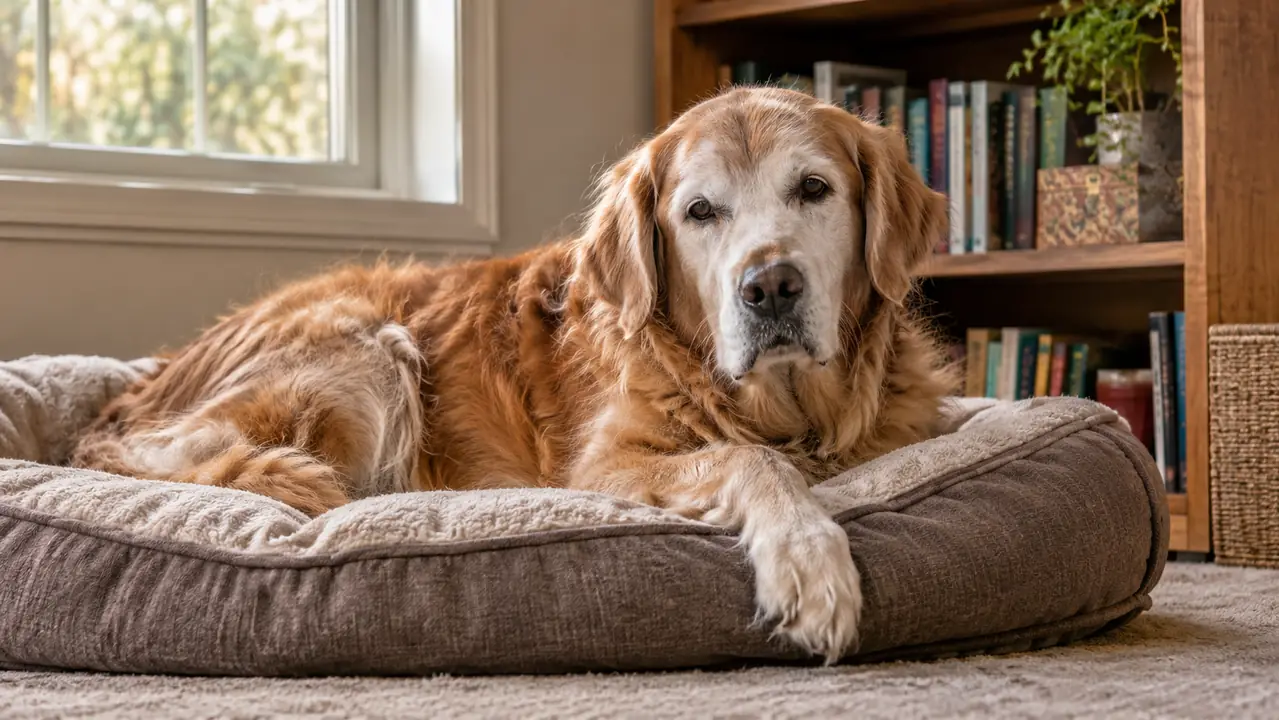
The thing nobody tells you about an old dog is that the furniture starts to win. In October 2024 our Brittany mix, Gus, quit hopping onto the low loveseat in the den. He would walk up to it, put his front paws on the cushion, stand there thinking, and then back away and lie on the carpet instead. He was twelve years old and forty-six pounds. X-rays that November showed arthritis in both hips, worse on the left. What I noticed first was not a limp. It was the pause. Thirty-one years of taping ankles at a high school taught me that a body tells you where it hurts by how it hesitates, not by how it looks.
We bought the Bedsure orthopedic dog bed in March 2025. It replaced a flat pillow-style bed that had been on the den floor for six years and had gone about as flat as a folded towel. I am writing this because the bed helped and because it did not fix what I half hoped it would fix, and both of those things deserve to be in the same review. Gus is not a puppy and this is not a story about a turnaround. It is a story about a dog getting off the floor a little easier in the morning.
The Quick Verdict
The foam has held its shape through twenty months of nightly use and Gus rises easier in the morning. It is not a treatment for arthritis, the four bolsters eat more of the sleeping space than the product photos suggest, and the listing's weight field is wrong for a bed this size.
Amazon Check Today's Price →Twenty months on a den floor and the foam still has not flattened
That is the whole test for me. A dog bed is furniture that gets leaned on every night by an animal who cannot tell you it has gone soft in the middle. This one has held. Check the current price and the size chart together, because the footprint is smaller than the word large implies.
Amazon Check Today's Price on Amazon →How I've Used It, and for How Long
The Bedsure bed sits in the corner of the den, on carpet, between the loveseat and the bookshelf. That corner catches the morning light and it is where Gus has always gone to sleep, so I did not have to teach him anything. I set the bed down where the old one had been and he walked onto it that evening without ceremony. He is on it most nights and a good part of most afternoons. Mike and I step over it constantly, which is a fair sign of a bed in the right place.
Before I ordered, I did what I would have told any kid with a new brace to do: I measured. I had Mike hold Gus still on the kitchen tile and I ran a tape from the tip of his nose to the base of his tail. Forty-one inches, which told me the thirty-eight inch bed was going to be close. It has been close, and it has been fine, because Gus curls. If he had been a dog who slept stretched out flat, I would have needed something longer, and I would rather tell you that now than have you find out on your own floor.
Gus is forty-six pounds. The bed measures thirty-eight inches long by twenty-eight inches wide by six and a half inches thick, per the listing, and it weighs a little under seven pounds. He fits on it with room at his head. He does not fit with room to sprawl the way he sprawls on the carpet. If your dog sleeps stretched out like a rug, measure him nose to tail base before you order, because a bolster on all four sides means your dog sleeps in the middle, not corner to corner.
The cover comes off. I wash it about once a month, more in the wet months when his feet come in muddy. Twenty months in, the foam still has its shape. I press it with my palm the way I used to press a pitcher's shoulder looking for the soft spot, and I have not found one. The flat bed we had before this went pancake-flat inside two years. This one has not, and that is the single most useful thing I can tell you about it.
What the Bed Actually Is, Going by the Listing and by My Own Hands
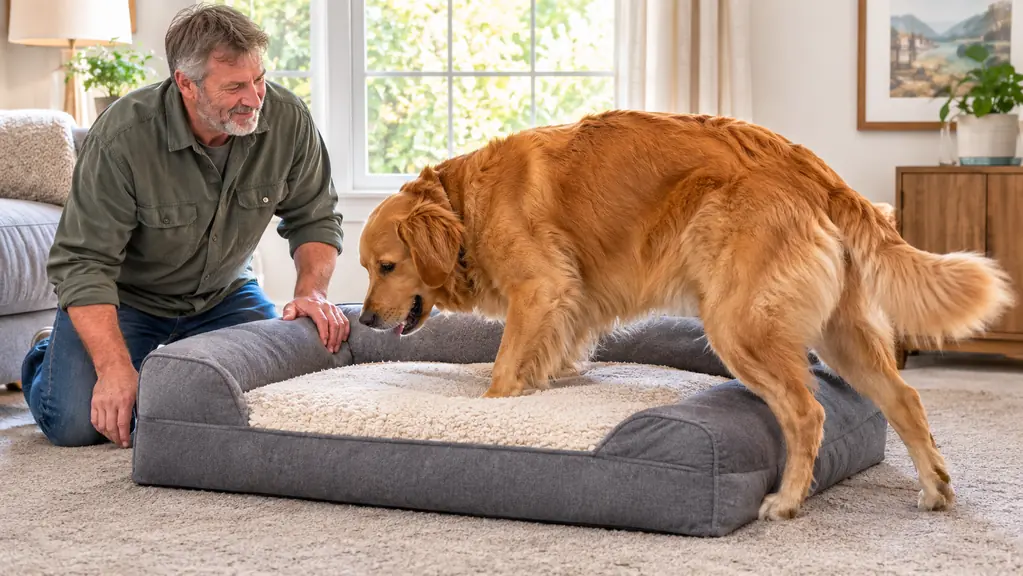
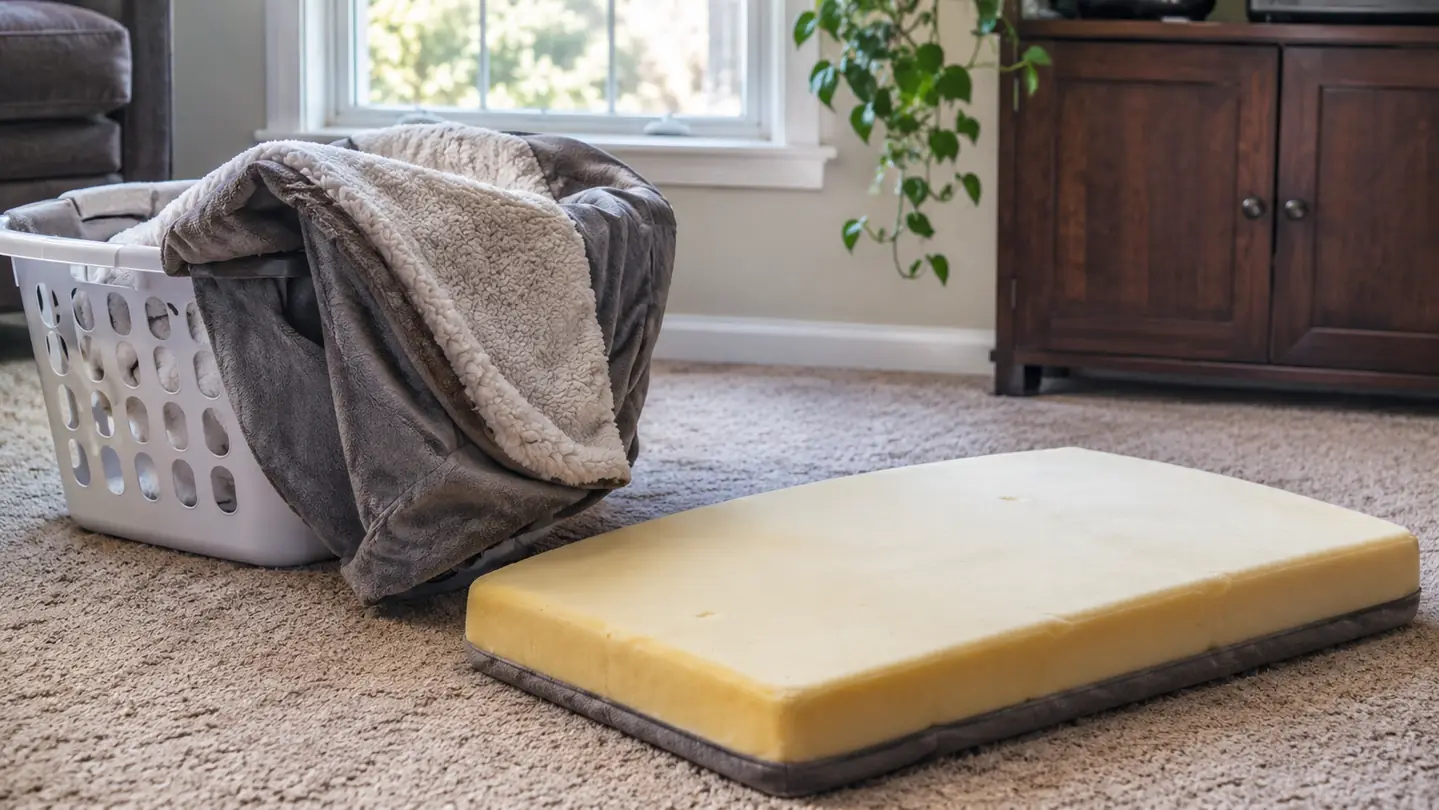
The listing describes egg-foam with a bolster on all four sides, a removable cover, and a waterproof layer beneath it. The foam is CertiPUR-US certified and the cover carries OEKO-TEX Standard 100 certification. I am not a chemist and I cannot verify a certification from my den. What I can tell you is that the bed did not smell like anything when it came out of the box, which is more than I can say for a foam mattress topper we bought once, and that counts for something in a one-story house with the windows shut in March.
That waterproof layer sits under the cover, not on top of the sleeping surface. It matters, because a membrane at the surface would feel like a tarp under a dog's hip and this one does not. The first real test came in the spring of 2025, when Gus came in from a wet morning with his underside soaked through. I checked the foam that afternoon and it was dry. I have checked it twice since, both times after a muddy week, and both times it was dry. That is a small thing right up until the night it is not.
The bolsters are the part I have the strongest opinion about. They are filled and they are firm. They give Gus something to push against when he rises, and I believe that is doing real work for him. They also mean the flat sleeping area is smaller than the outer dimensions suggest. Take the thirty-eight by twenty-eight footprint and subtract a bolster on every side, and the usable middle is closer to what I would call a medium bed. That is the gap between the photos and the thing on my floor.
One more note on the listing, because it nearly cost me the purchase. The weight recommendation field says fifteen pounds. That cannot be right for a bed sold as a large size, and I ignored it. Go by the dimensions and by your dog's length instead. Gus is forty-six pounds and he is fine on it. A sixty-pound dog that curls up would also be fine. A sixty-pound dog that stretches out would not.
What Changed, and How Fast
Within about two weeks I noticed the mornings. Gus sleeps in the den and he used to come off the floor in stages, front end up, then a pause, then the back end. After two weeks on the Bedsure bed he was rising in one motion again, or close to it. I want to be careful here. That is one dog, one bed, and no control group. He had also started a joint chew in November 2024 and salmon oil in January 2025, both at Dr. Renner's suggestion, so I cannot hand the whole improvement to a piece of foam. What I can say is that the timing lined up with the bed.
I keep a notebook. I started it in November 2024, after the vet visit, because thirty-one years of watching kids come back from a sprained ankle taught me that memory is a liar about slow progress. Every morning I wrote one line: how Gus came up off the floor, how he took the porch steps, whether he tried the loveseat. The March entries all say some version of the same thing. Up in stages. The line for April 3, 2025, a little over a week after the bed went down, reads: one motion. It stayed one motion most of that spring. Nothing else in that notebook changes like that, and I have gone back and read it twice to be sure I was not flattering myself.
The other change was smaller and, to me, more interesting. He stopped doing the hesitation ritual before getting on it. Our old flat bed sat low, so there was nothing to step over. The new one is six and a half inches thick with a bolster on the near side. Early on he stepped onto the bolster and sort of slid into the middle. After a week he was stepping over the bolster and into the middle in one motion, like a kid clearing a low fence.
That is the thing about a body. It learns a new set of steps in a week if the steps are predictable, and it never learns them if they shift underneath. The foam on this bed does not shift. The cover is snug enough that it does not slide around under a dog's feet. If you have ever watched an older dog lose his confidence on a surface that moved, you know why that matters more than the thickness number on the box.
Twenty months in, I press that foam with my palm looking for the soft spot, and I still have not found one.
The Parts I Do Not Love
The bolsters are firm, and firm cuts both ways. Gus likes to rest his chin on one and that is plainly comfortable for him. But the front bolster is the reason an older dog has to step up and over to get on the bed at all. On a bad morning that six and a half inches is a small obstacle, not a big one, but it is an obstacle. If your dog is struggling with something taller than this, a bed will not solve it. We ended up buying a ramp for the loveseat for exactly that reason.
The cover is a two-person job the first time and a one-person job after that. There is a zipper that runs around the base, and the foam inside is one piece, so you are wrestling a fairly large slab of foam back into a fairly snug piece of fabric. It takes me about five minutes now. I have done it twenty times and I no longer dread it, but the first time I said a few things I would not repeat in front of the kids.
Laundry day has a shape in our house now. The cover comes off in the morning, goes in on a normal cycle, and if the weather is decent it is dry on the line by afternoon. If it is not decent, it hangs over the back of a kitchen chair and is dry by the next morning, and Gus sleeps on the bare foam that night with a towel laid over it. He does not mind. I mind a little, because it means the bed is out of service for a day, and a dog with sore hips does not get a day off from needing somewhere soft to land. That is the argument for a second cover, and I have not bought one yet.
And the size. Thirty-eight inches sounds bigger than it looks once it is on a floor. Twice now a visitor has asked me whether that is the large one. It is. The bed is built for a dog that curls, and Gus curls about half the time and drapes his head off the edge the other half. That is not a defect in the bed. It is a mismatch between the bed and one dog's sleeping style, and you should figure out which dog you have before you order.
What I Liked
- The egg-foam has kept its shape through twenty months of nightly use
- Firm bolsters give an older dog something to push against when rising
- Cover unzips and washes, about once a month in our house
- The waterproof layer sits under the cover, so the sleeping surface stays dry and soft
- Fits into a den corner without taking over the room
Where It Falls Short
- Four bolsters shrink the usable sleeping area inside the thirty-eight by twenty-eight footprint
- Six and a half inches of foam plus a bolster is still a step up for a stiff dog
- The listing's weight recommendation field misleads anyone buying for a large dog
- Getting the foam back inside the cover takes some wrestling
- Not enough flat room for a dog that sleeps stretched out
What It Did Not Do
The bed did not fix the porch steps. Our house is one story, and the only stairs Gus deals with are the three wooden ones off the back porch. He is slower on those than he was a year ago and no bed changes that. The bed did not stop the evening in June 2025 when he misjudged a jump onto the loveseat and slid back down, which is why there is now a ramp beside it. A bed is a place to sleep. It is not a piece of equipment, and it does not replace one.
It also did not take the place of anything Dr. Renner has told us. She suggested the joint chew, she asked us to keep his weight down, and she said prescription pain medication is something to revisit later rather than something to start now. Gus is not on it. If you are reading this hoping a dog bed is the answer to a dog who is struggling, call your vet first and buy the bed second. That is not a disclaimer at the bottom of a page. That is the order I would do it in.
Who This Is For
This is for the household with a middle-aged or older dog who has started sleeping on the floor instead of the bed he used to use, or who gets up in stages in the morning. It suits a dog that curls. And it suits someone who wants a bed that will still have foam in it three years from now, and who is willing to wash a cover once a month to get that.
Put it on carpet or a rug if you can. We have tile in the kitchen and carpet in the den, and the one time I dragged the bed into the kitchen to wash the den floor, it slid a couple of inches every time Gus pushed off it to stand. Nothing dramatic, and he did not seem bothered, but I moved it back that afternoon. A foam base on a hard floor wants something under it, and a dog who is already unsure of his footing does not need the ground moving.
Who Should Skip It
Skip it if your dog sleeps flat out with the legs stretched, because the bolsters will be in the way and you will be paying for foam your dog never touches. Skip it if your dog needs help getting up something taller than a curb, because a bed is not that help. And skip it if you want the bed to be the whole plan. A bed, a ramp, a sling for the bad mornings and whatever your vet recommends. In our house that is what comfort for a twelve-year-old dog actually looks like, and no single item on that list carries it alone.
The honest summary after twenty months is this. The Bedsure bed is the item on that list I would buy again first, and it is not the item that made the largest difference in how Gus moves. It made the difference in how he rests, and in an old dog those are not the same thing. Ask your vet about the hips. Buy the bed for the sleep. Then measure your dog's length before you click anything.
Buy it for the sleep, not for the diagnosis
Twenty months of nightly use, one cover washed about twenty times, and foam that still pushes back. Sizing is the one thing to get right before you order, so measure your dog nose to tail base and compare that to the thirty-eight by twenty-eight footprint.
Amazon Check Today's Price on Amazon →